How to Hire a SW Development Company That Delivers Real ROI
Discover how a sw development company helps Belgian SMEs define scope, compare costs, and launch projects confidently.
Jan 5, 2026

Finding the right software development partner can feel like a huge gamble, especially when you're not a tech expert. But it doesn't have to be a shot in the dark. This guide is for business owners and entrepreneurs who know they need custom software but aren't sure where to begin. We’ll cut through the technical jargon and give you a straightforward, practical roadmap for finding a team that truly gets your business goals and delivers measurable results.
Your Starting Point: Finding the Right Partner
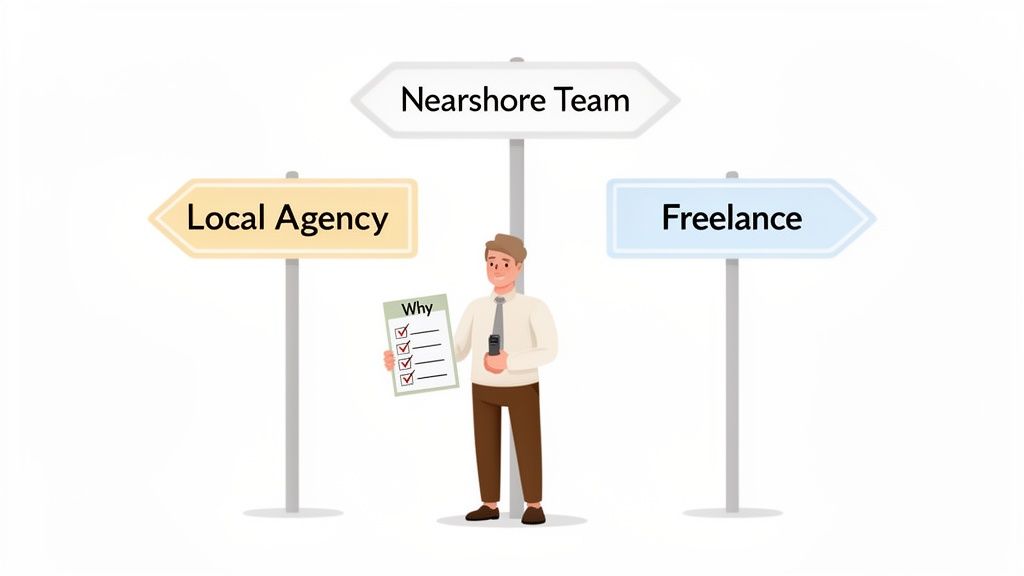
The journey to building great software begins long before you write a single line of code. The most important thing you can do is define your 'why'—the core business problem you're trying to solve. Without this clarity, you risk spending a lot of money on a tool that nobody uses.
Are you looking to automate a manual process that's eating up your team's time? Do you want to create a better customer experience to boost loyalty? Or are you launching a completely new digital product to open up a new revenue stream? Nailing this down is everything.
A little bit of planning here will save you a world of pain, time, and money later. It’s all about translating a business headache into a clear goal a technical team can execute.
Defining Your Core Business Need
Before you even think about evaluating a sw development company, you have to look inward. Start by answering a few simple questions. Forget the technical side for a moment; think purely in terms of business outcomes.
What problem are we solving? For an e-commerce shop, it might be, "Customers are abandoning their carts at checkout." For a professional services firm, it could be, "Our client onboarding is a mess of emails and spreadsheets."
Who is this for? Is the end-user your customer, your internal team, or both? Knowing your audience is non-negotiable. An app for your sales team has very different needs than a portal for your clients.
What does success look like? This is the most critical question. How will you measure the return on this investment (ROI)? Be specific. Success might be a 20% reduction in manual data entry, a 15% increase in customer retention, or generating €5,000/month in new subscription revenue. According to a study by McKinsey, companies that focus on clear business outcomes are 1.5 times more likely to report a successful digital transformation.
This simple exercise ensures you're building a tool that delivers real value, not just tech for tech's sake.
Understanding Your Partner Options
Once you've got a solid grip on your business need, you can start exploring the different types of partners out there. Each model has its own pros and cons, and the right choice depends on your budget, timeline, and how complex your project is.
The European software development market is booming, projected to grow at a compound annual growth rate (CAGR) of 6.9% from 2020 to 2025. This growth means you have more high-quality options than ever before.
Actionable Takeaway: The biggest mistake business owners make is rushing to find a developer without first defining the problem. A great development partner can build anything, but they can't read your mind. Your job is to provide the map; their job is to drive the car.
Let's break down the main partner models you'll encounter.
Choosing Your Development Partner Model
Deciding between a local agency, a nearshore team, or a freelancer is a critical first step. Each has its place, depending on your project's complexity, budget, and how much hands-on involvement you want.
Partner Type | Best For | Pros | Cons |
|---|---|---|---|
Local Agency | Complex projects needing deep collaboration, local market knowledge, and face-to-face meetings. | Excellent communication, cultural alignment, easy in-person collaboration, strong accountability. | Highest cost, smaller talent pool compared to the broader European market. |
Nearshore European Team | Cost-sensitive projects that still require high-level technical skills and real-time collaboration. | Great balance of cost and quality, access to a vast talent pool, minimal time zone differences. | Potential for minor cultural or language nuances, requires strong remote communication skills. |
Freelancer | Small, well-defined tasks, augmenting an existing team, or projects with tight budgets. | Most budget-friendly, highly flexible, direct communication with the developer. | Risky dependence on one person, limited skillset for complex projects, availability can be an issue. |
Real-World Use Cases:
A Brussels-based fintech startup might choose a local agency to navigate complex Belgian financial regulations.
A growing SaaS company could hire a nearshore team in Poland to build out new product features cost-effectively.
A small e-commerce store might hire a freelancer to build a custom Shopify plugin.
When you're ready to start your search, using a structured framework is incredibly helpful. This guide to choosing a tech agency offers a solid approach to the evaluation process. Getting this choice right from the beginning sets the tone for the entire project.
Translating Your Vision into a Clear Project Scope
A vague idea is the most expensive thing you can bring to a software project. Before looking for a software development company, your first job is to get that brilliant concept out of your head and onto paper in a way a technical team can actually build.
Don’t worry, you don’t need a computer science degree for this. It’s about thinking from your user's perspective first. This groundwork is your best defense against "scope creep"—the notorious project killer that quietly adds features, time, and cost until your budget is a distant memory.
Frame Features with User Stories
Instead of listing dry technical requirements, frame every feature as a simple "user story." This is just a plain-language sentence that puts a real human need at the center of what you're building. The format is simple but incredibly effective: "As a [type of user], I want to [perform some action], so that I can [achieve some goal]."
This small shift in perspective forces you to justify every feature with a genuine benefit.
E-commerce Example: "As a returning customer, I want to view my past orders, so that I can quickly re-purchase my favorite items."
Professional Services Example: "As a new client, I want to upload all my onboarding documents through a secure portal, so that I can avoid sending sensitive information over email."
SaaS Example: "As a team manager, I want to see a dashboard of my team's weekly progress, so that I can easily spot bottlenecks."
Writing these stories helps a development team understand the why behind the what, which leads to a much better end product.
Prioritise Ruthlessly with the MoSCoW Method
You can't build everything at once, especially with a budget. This is where prioritization becomes your best friend. The MoSCoW method is a simple framework for sorting your features into four essential categories:
Must-have: The non-negotiables. Without them, the software is unusable. Think 'user login' or 'add to cart'.
Should-have: Important features that add value but aren't critical for the first launch. The product works without them, but it’s less effective. Example: 'product reviews'.
Could-have: Nice-to-have features or small improvements. They’d be great if time and budget allow, but their absence won't hurt. Think 'related product recommendations'.
Won't-have (for now): Features explicitly out of scope for this version. This is crucial for stopping scope creep and keeping everyone focused.
Actionable Takeaway: Clearly defining what you won't build gives your project focus. You can always add 'Could-have' features later, but trying to do everything at once is a recipe for failure. A key part of this is creating a clear product roadmap that visually lays out your software's strategic direction.
Validate Your Ideas with Real Feedback
Before you invest thousands into development, you need confirmation that you're solving a real problem. Gathering initial feedback is easier than you think and doesn't require a single line of code.
This screenshot shows how a tool like Weavely.ai lets you quickly build surveys or interactive forms to test your assumptions. You can ask potential users about their pain points, what features they'd value, and even what they might be willing to pay.
This data is gold. It turns your project scope from a document based on guesswork into a plan grounded in real user demand, dramatically increasing your chances of a successful ROI.
This level of detailed planning will make your first conversation with a potential partner infinitely more productive. For a deeper insight, our guide on how to develop web applications with a clear strategy is a useful next step.
Decoding Engagement Models and Development Costs
Picking how you'll pay a sw development company isn't just a financial decision—it’s a strategic one that shapes your project's flexibility, timeline, and final outcome. Getting this right from the start is crucial for setting realistic expectations and avoiding budget surprises.
Think of these models as different tools for different jobs. The best model depends entirely on how clear and stable your project scope is.
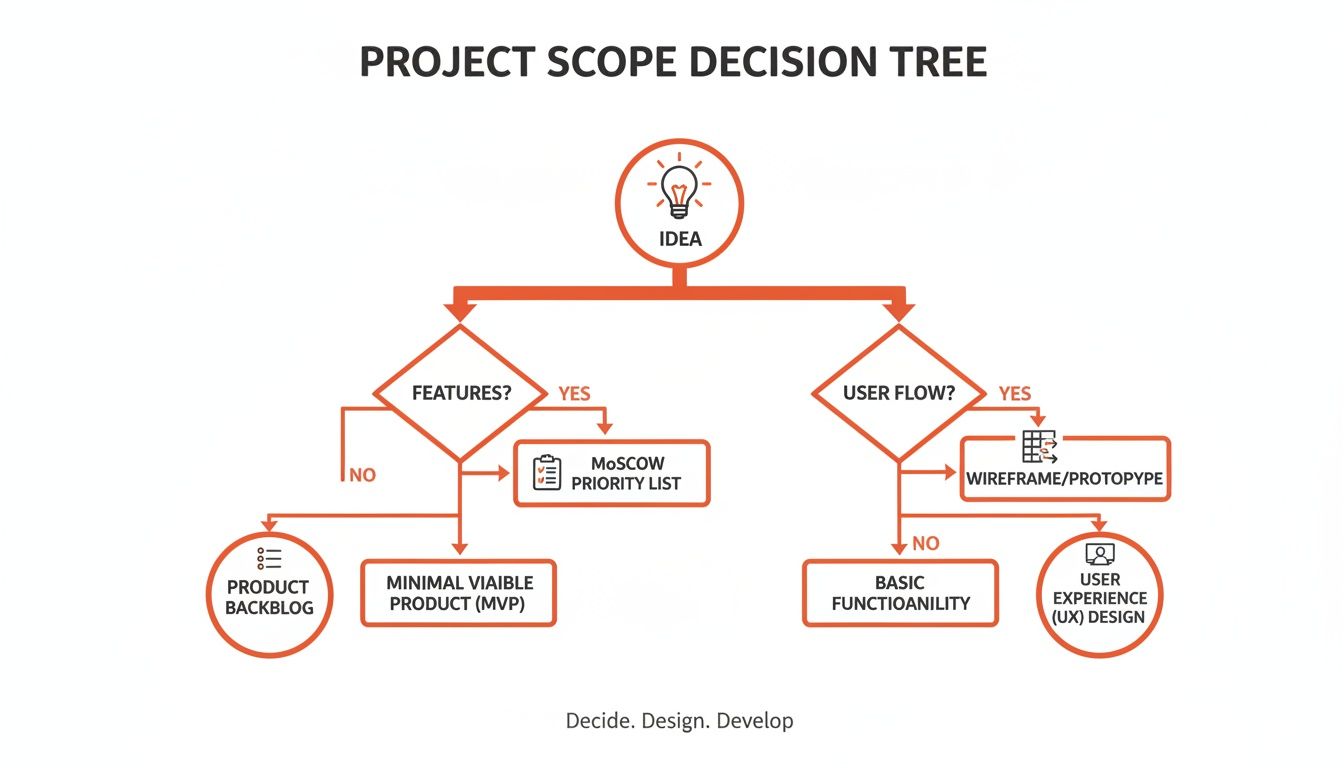
As the flowchart shows, a well-defined idea with clear features is ready for a more structured, predictable development approach.
The Fixed Price Model: Certainty for a Price
The Fixed Price model is exactly what it sounds like. You agree on a specific scope of work for a set price. It’s wonderfully straightforward and predictable.
Best For: Small, clearly defined projects where requirements aren't likely to change. Think a simple marketing website, a basic mobile app, or a Minimum Viable Product (MVP) with a locked feature set.
Real-World Example: A local bakery wants a new five-page website with an "About Us" page, a menu, a gallery, and a contact form. The features are crystal clear, making it a perfect fit for a fixed price of, say, €8,000.
The main benefit is budget certainty. The downside is rigidity. If you suddenly need an online ordering system, that requires a new quote and contract, which slows things down.
The Time & Materials (T&M) Model: Flexibility and Agility
With a Time & Materials (T&M) model, you pay for the actual time developers spend on your project at an agreed-upon hourly or daily rate.
Best For: Larger, complex projects where requirements are expected to evolve. This is the standard for custom software development, like building a bespoke CRM or an e-commerce platform with unique integrations.
Real-World Example: A consulting firm wants to build an internal client management portal. They have a core set of features but expect user feedback during development to lead to changes. T&M gives them the freedom to adapt and refine the software as they go.
This model offers maximum flexibility. The trade-off is that the final cost isn't fixed, which requires a high level of trust and transparent communication with your development partner. For projects where the scope is still evolving, you might also explore low-code and no-code platforms for rapid prototyping before committing to a full T&M build.
Interpreting Pricing Signals
When you get quotes, the price differences can be staggering. Be warned: a rock-bottom price is almost always a red flag. In software development, you get what you pay for. Extremely low rates often lead to poor code quality, communication barriers, and missed deadlines, costing you far more in the long run to fix.
Belgian Rates: Typically range from €70 to €150 per hour.
Nearshore European Rates: Often between €40 and €70 per hour for highly skilled developers.
A staggering 73.2% of companies seeking to outsource software development target Europe, highlighting the region's reputation for quality and value. A good-value quote isn't the cheapest one. It's the one that comes from a team that asks smart questions, shows they understand your business goals, and provides a detailed breakdown of their estimate.
How to Vet and Interview Potential Partners
You’ve got a shortlist of potential partners. Now it’s time to separate the true experts from the polished sales teams. This is where you move beyond their portfolio and ask the tough questions that reveal how they really operate.
Remember, you're looking for a long-term partner who is as invested in your business's success as you are. A good interview is about understanding their process, communication style, and how they handle pressure.
Assessing Technical and Project Management Skills
You don't need to be a coding whiz to ask smart questions. Your goal is to understand their reasoning, not to quiz them on programming syntax. How a sw development company manages a project is just as vital as the code they write.
Start by asking about their preferred technology. A great follow-up is, "And why is that the right choice for my project?" An expert partner will explain their choice in business terms, like scalability, security, or long-term maintenance costs.
Next, pivot to project management. Poor communication can sink any project.
Communication Cadence: Ask if they have weekly check-in calls or provide progress reports.
Tools of the Trade: What project management tools do they use? Ask to see an example of a project board.
Handling the Unexpected: My favorite question is: "Tell me about a time a project went completely off the rails. What did you do to get it back on course?" Their answer reveals their accountability and problem-solving skills.
This screenshot shows a typical project board, like those in tools such as Trello or Jira, where tasks are organized visually.
Seeing how a company lays out its workflow gives you insight into their organization and transparency.
Evaluating Cultural Fit and Past Performance
Technical skill is only half the battle. You need a partner who is on your team. This "cultural fit" comes down to shared values, communication styles, and a mutual grasp of your business goals. A team that asks insightful questions about your customers and revenue model is a team that cares.
The best predictor of future performance is past performance. Don't just glance at their portfolio; talk to their previous clients.
When you speak to references, go deeper than, "Were you happy?"
Actionable Takeaway: Ask targeted questions that reveal the true nature of the partnership. Focus on outcomes, budget adherence, and how they handled challenges. This is your chance to see what it's really like to work with them.
Here are a few powerful questions to ask past clients:
Did the final project actually meet the business goals you originally set?
How did the company handle your feedback and changes during development? Were they flexible or rigid?
Was the project delivered on time and within the agreed budget? If not, how did they manage the overages?
The big one: Would you hire them again for another critical project? The answer is often the most revealing.
This vetting process ensures you find a genuine partner who will help you navigate the complexities of software development and deliver a product that drives real business growth.
Navigating Contracts and Kicking Off the Project Right
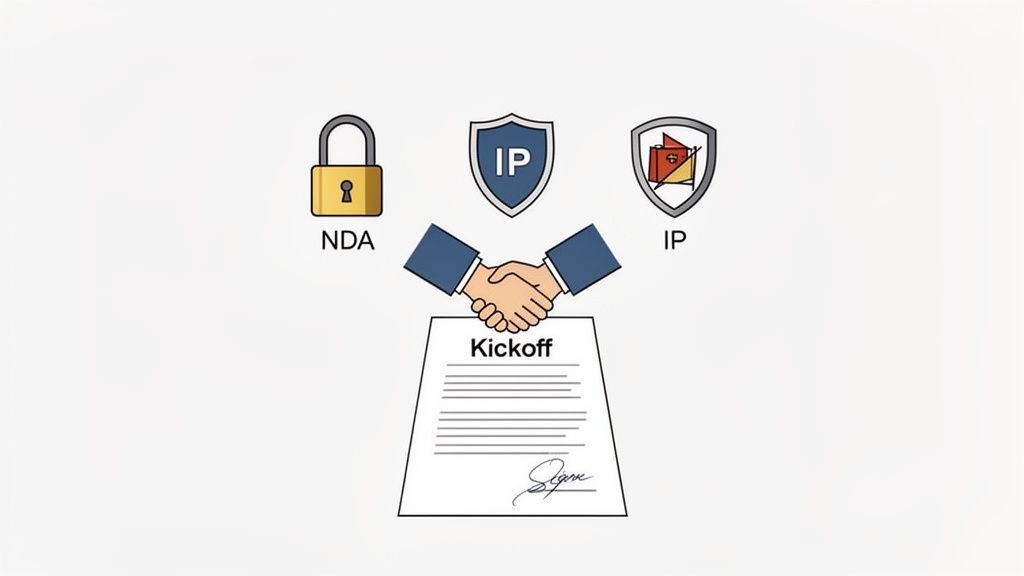
You've interviewed candidates, checked references, and picked your development partner. It’s an exciting step, but before any code gets written, you need to lock down the legal side of things.
Think of the contract as the safety net for your entire project. It’s not just a formality; it's the document that protects your business, your intellectual property (IP), and your investment. A strong legal foundation is the secret ingredient for a smooth partnership.
Key Contract Clauses You Cannot Ignore
Don't just skim the fine print. As a business owner, there are a few non-negotiable clauses you must scrutinize to protect your interests.
First, and most important, is the Intellectual Property (IP) Ownership clause. The contract must state, without ambiguity, that you—the client—own 100% of the final source code once the final payment is made. If this isn't crystal clear, the agency could technically own the software you paid them to create.
Next is the Non-Disclosure Agreement (NDA). This legally binds the development company to keep your business idea and sensitive data completely confidential.
Finally, pay close attention to the Data Security and Privacy terms. With GDPR in full force, ensuring your partner follows strict data protection protocols isn't just good practice—it's a legal necessity.
A contract isn't about mistrust; it’s about clarity. A professional development partner welcomes a detailed agreement because it protects them just as much as it protects you, creating a transparent and accountable relationship from the outset.
The Blueprint for a Successful Project Kickoff
With the contract signed, it’s time for the official project kickoff. This meeting is more than introductions; it’s the strategic session that sets the tempo for the entire project. The goal is to get both teams perfectly aligned on the vision, process, and expectations.
Your kickoff agenda should nail down three core areas:
Set Up Communication Channels: Decide exactly how you'll communicate. A dedicated Slack channel for quick questions? A standing weekly video call for updates? Defining this now prevents messages from getting lost later.
Define Roles and Responsibilities: Make it clear who the main point of contact is on both sides. Your team needs to know who the project manager is, and they need to know who on your side has the final say on feature approvals.
Confirm the Initial Roadmap: Walk through the high-level project plan and agree on the goals for the very first "sprint" or development cycle. This ensures everyone is pulling in the same direction from day one, a crucial step in managing the overall product management life cycle.
A well-run kickoff meeting transforms a contractual agreement into a genuine working partnership, building momentum right from the start.
Common Questions About Hiring a SW Development Company
Stepping into the world of custom software can feel intimidating. You have the vision, but the path to building it is filled with questions. This section gives you straightforward answers to the most common concerns business owners have when they decide to hire a sw development company.
How Much Does It Cost to Hire a SW Development Company?
This is always the first question, and the honest answer is: it depends. Cost is driven by your project's complexity, the technology used, and the team's location.
Common Objection: "Custom software sounds expensive. Can my small business really afford it?"
While it's a significant investment, think about the ROI. If a €30,000 application saves your team 20 hours of manual work per week, it could pay for itself in under a year.
To give you a realistic picture:
Local Rates: Expect hourly rates from €70 to €150. You're paying a premium for face-to-face collaboration.
Nearshore European Rates: Teams in countries like Poland or Romania often charge €40 to €70 per hour for top-tier developers.
Project-Based Costs: A simple marketing website might cost €5,000-€15,000. A custom web application could easily run from €25,000 to over €100,000.
Actionable Takeaway: Focus on value, not just price. A cheap quote often leads to costly rewrites and missed deadlines. Fixing bad code is always more expensive than building it right the first time.
What Is the Difference Between a Freelancer and a Development Company?
Choosing between a solo expert and a full team hinges on the scale and importance of your project.
A freelancer is a single specialist. They can be a fantastic, cost-effective choice for smaller, well-defined tasks—like building a landing page or adding a single feature to an existing app.
A software development company brings a complete team: a project manager, UX/UI designers, multiple developers, and quality assurance (QA) testers.
For a mission-critical business application, a company is almost always the safer, more scalable option. You're not just hiring coders; you're getting a broad range of expertise and the reliability of a full team.
How Do I Manage the Project If I Am Not Technical?
This is a common and valid concern. The good news is, you don't need to be a coder to lead a software project. Your job is to be the expert on your business—let them be the technical experts.
A reputable company will assign a Project Manager (PM) as your main point of contact. The PM’s role is to translate your business needs into clear technical tasks.
Your responsibilities are simple but crucial:
Provide Clear Feedback: Give specific and timely feedback from a user's perspective.
Be Available for Questions: Your prompt answers keep the project moving forward.
Stay Engaged: Make time for regular check-in meetings and use their project management tools (like Jira or Trello) to keep an eye on progress.
Should I Choose a Local Company or Outsource Abroad?
The decision between a local partner and a nearshore team comes down to balancing communication, cost, and access to talent.
A local company offers the advantage of in-person meetings and a shared cultural context, which can make communication feel effortless. But this convenience usually comes with a higher price.
Nearshoring to countries in Eastern Europe provides a compelling financial advantage, often cutting development costs significantly without a drop in quality. With minimal time zone differences, real-time collaboration is still perfectly manageable.
For many businesses, a nearshore European partner strikes the perfect balance between world-class talent, cultural alignment, and cost-effectiveness, delivering the best overall value.
