A Founder's Guide to the Product Management Life Cycle
Master the product management life cycle with our step-by-step guide. Learn the key stages, tools, and strategies to turn your idea into a successful product.
Dec 19, 2025
The product management life cycle is really just a simple roadmap that guides a product from its initial spark of an idea right through to its market launch and beyond. Think of it as your game plan for turning a great concept into a successful, profitable reality. Following it helps you sidestep common pitfalls and seriously boosts your chances of creating something customers will love and pay for.
Why the Product Management Life Cycle Matters for Your Business
For a small or medium-sized business owner, the product management life cycle isn't some rigid corporate process you have to follow to the letter. It’s a flexible framework that helps you make smarter, more strategic decisions along the way.
When you consider that some studies show as many as 95% of product launches fail, having a structured approach isn't a luxury—it's essential for survival and growth.
This framework is your best defense against the most common and costly mistake entrepreneurs make: building something nobody actually wants. By following a logical progression, you ensure every ounce of effort and every dollar spent is aimed squarely at solving a real, validated customer problem.
The Chef Analogy: A Simple View
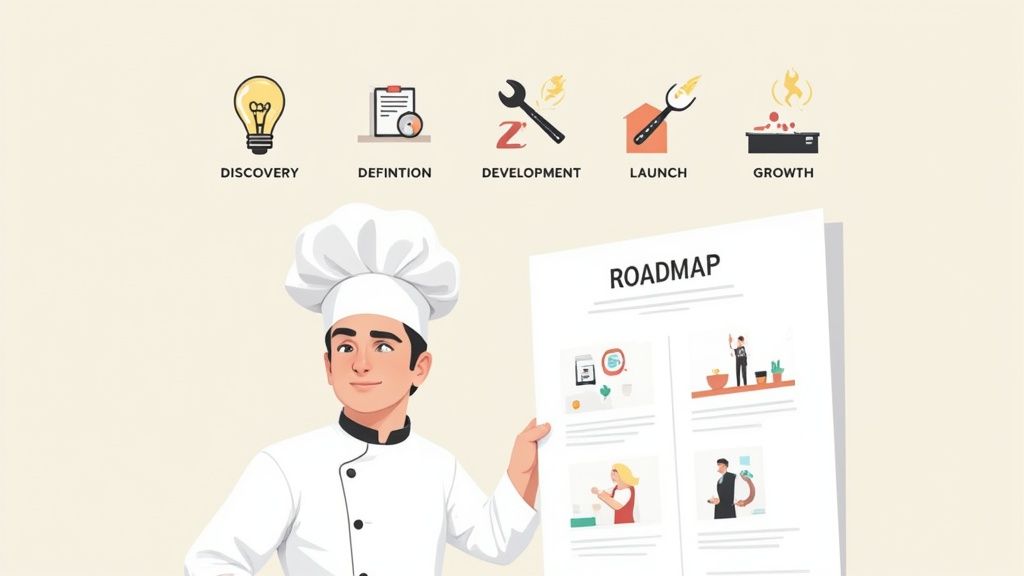
Imagine you're a chef opening a new restaurant. You wouldn't just start throwing ingredients in a pan without a plan, would you? You'd naturally follow a life cycle:
Discovery: You spot a gap in the local food scene. Maybe there's a real craving for authentic Italian pasta that no one is satisfying. This is market research.
Definition: You design the menu, nail down the restaurant's theme, and define the entire dining experience you want to create. This is your product vision and strategy.
Development: You build out the kitchen, hire and train your staff, and spend time perfecting every single recipe. This is the building phase.
Launch: Grand opening! You finally open the doors to the public. This is your go-to-market plan.
Growth: You listen to what your customers are saying, tweak your dishes based on feedback, and add specials to keep diners coming back for more. This is iteration and improvement.
This is the core flow of the product management life cycle, moving from that initial idea to sustained growth in the market.
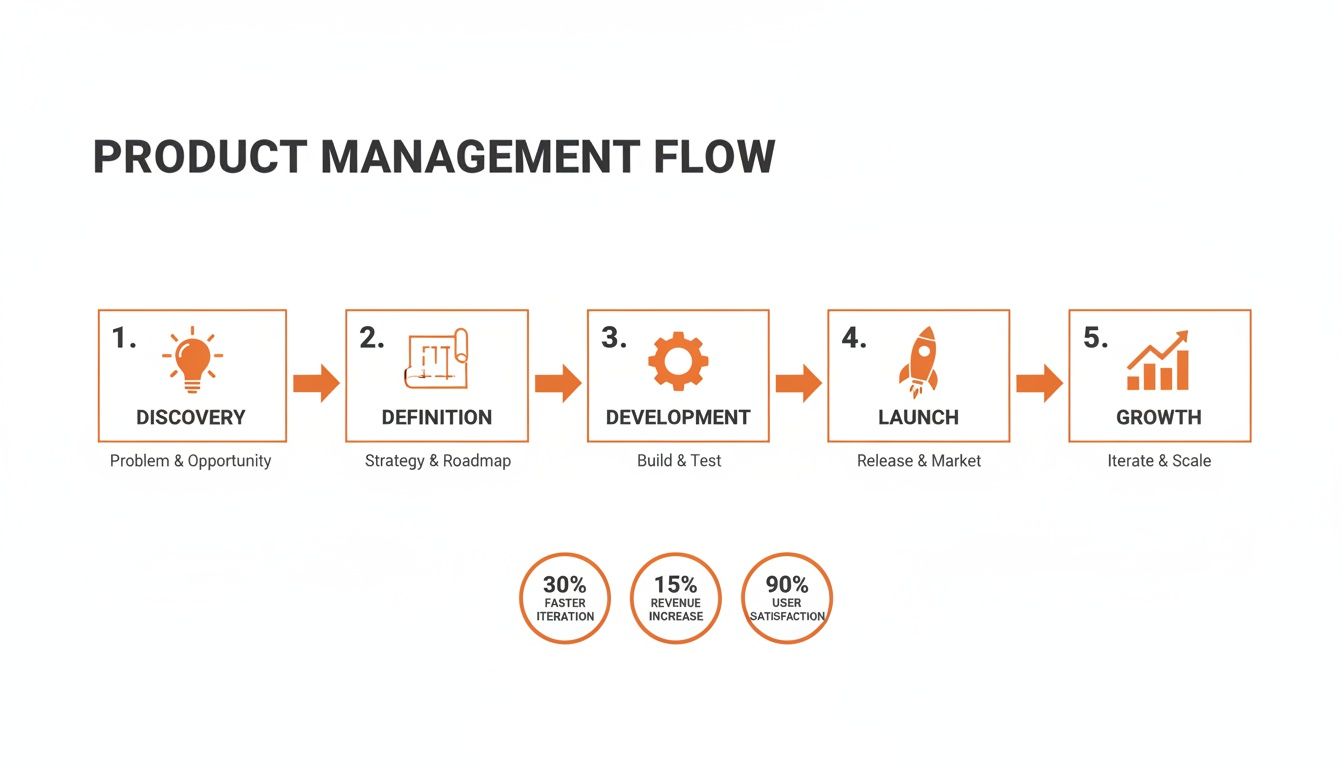
Each stage builds on the one before it, creating a logical path that cuts down on guesswork and gets your entire team aligned on a single, clear goal. For a deeper dive into the whole journey, it's worth checking out Mastering the Product Development Lifecycle Stages.
Tangible Benefits for SMEs
Adopting a structured process like this brings clear, tangible benefits that directly improve your ROI. It's not about adding needless complexity; it's about building a solid foundation for scalable success.
The primary goal is to shift from building based on assumptions to building based on evidence. This simple change dramatically increases the odds of creating a product that customers not only need but are also willing to pay for.
By focusing on this framework, you’ll quickly see improvements in a few key areas:
Reduced Risk: You validate ideas early with real customer feedback, stopping you from pouring money into a product that's doomed from the start. This directly protects your investment.
Improved Alignment: Everyone, from marketing to your developers, understands the 'why' behind the product. This leads to much better collaboration and faster progress.
Smarter Resource Allocation: It helps you prioritize which features to build first, ensuring your limited budget is spent on what truly matters most to your customers.
Increased ROI: A product that solves a real problem is a product that sells. This process is your best tool for ensuring you achieve product-market fit and, ultimately, profitability.
From Bright Idea to Concrete Plan
Every great product starts with that spark of an idea, but the real magic happens when you shape that spark into a concrete, actionable plan. This is where the product management life cycle truly begins, blending initial discovery with strategic definition to build a solid foundation.
And no, you don't need a massive budget or a dedicated research team. As a business owner, you just need to be smart about how you listen to your market.
It’s so tempting to jump straight into building, but taking a moment to confirm there's a real need for your product will save you a world of pain, time, and money later. After all, the costliest mistake you can make is building something nobody actually wants.
Uncovering Customer Needs on a Budget
Market research often sounds expensive and intimidating, but for a small business, it’s all about being resourceful. Your goal is simple: find the gap between what customers have and what they genuinely need.
Let’s walk through a practical example. Imagine you run a professional services firm—say, an accounting practice—and you've got an idea for a new "startup CFO" package. How do you validate it?
Snoop on Competitor Reviews: Look up other local accounting firms on Google or niche review sites. What are the common complaints? Maybe clients feel nickel-and-dimed, can't get strategic advice, or find the onboarding process a nightmare. Those complaints are a goldmine of unmet needs.
Just Talk to Your Clients: Your existing customers are your best source of feedback. The next time you're on a call, ask them about their biggest financial challenges beyond basic bookkeeping. What do they wish they had more support with?
Run a Quick Survey: You can get structured feedback without spending a fortune. For example, a tool like Weavely.ai lets you build an AI-powered form in minutes. Email it to your client list and ask them to rank potential services in the new package. This gives you hard data to back up your gut feelings.
This listening tour is what takes you from, "I think this is a good idea," to, "I know this solves a real problem for my customers."
Defining Your Product Vision
Once you've got those insights, it's time to turn them into a clear product vision and a solid plan. This is the step that gets your whole team on the same page, making sure everyone knows exactly what you're building and—just as importantly—why.
Think of a strong product vision statement as your North Star. It’s a short, inspiring summary of what your product is all about.
For our accounting firm, the vision might be: "To provide early-stage startups with the strategic financial guidance they need to grow confidently, making expert CFO-level advice accessible and affordable."
This statement now guides every single decision you make about the service package. Does adding a particular report help a startup grow confidently? Does it make the service more accessible? If the answer is no, it’s probably not a priority right now. The customer experience is everything here; to really nail it, you might want to explore the fundamentals of UX/UI design and make sure your client interactions are seamless.
Prioritising What to Build First
With a clear vision, you can finally tackle the big question: what features or services do we offer first? As an SME, you can't offer everything at once. That’s where a prioritization framework comes in, and one of the most practical is the MoSCoW method.
It’s a straightforward way to sort features into four buckets:
Must-have: These are the absolute non-negotiables. Without them, the product is basically useless. For our accounting package, this would be monthly financial reporting and a quarterly strategy call.
Should-have: These are important features that add a lot of value but aren't critical for the very first launch. Think cash flow forecasting dashboards.
Could-have: These are the "nice-to-haves." Desirable, but not essential. You might add them later if you have the time and resources, like introductions to venture capitalists.
Won't-have (This Time): These are features that are explicitly out of scope for this version. This is crucial for managing expectations and avoiding "feature creep." For example, M&A advisory services would be a great idea for later, but it falls into this category for the initial launch.
Using a simple framework like this gives you a clear roadmap. You know exactly what your Minimum Viable Product (MVP) needs to include and what can wait, ensuring you can launch something valuable quickly without getting bogged down in bells and whistles.
Building and Launching Your Product
With your blueprint ready, it's time to roll up your sleeves and bring your product to life. The development and launch phases are where the magic happens—where ideas become tangible. For SMEs, the name of the game is staying lean, moving fast, and getting a working product into the hands of real users as efficiently as possible.
Forget about building the perfect, feature-loaded product on day one. Your goal is to build just enough to solve that core problem you pinpointed earlier. You launch that, listen carefully to what your first users say, and let their real-world feedback dictate your next move. This approach slashes your financial risk and stops you from sinking months into building something that nobody actually wants.
Embracing the Minimum Viable Product
The heart of this lean process is the Minimum Viable Product (MVP). Think of it as the most stripped-back, functional version of your product that still provides genuine value to your first customers. It’s not a buggy mess; it's a streamlined solution that nails the most critical "Must-have" you prioritized.
Imagine an e-commerce brand wanting to launch a subscription box service. Their MVP could simply be a hidden page on their website where customers can sign up for a single box type and pay via a simple checkout. Things like a customer portal to manage subscriptions or multiple box options? Those are "Should-haves" or "Could-haves" that can wait until the first batch of customers confirms they love the core concept.
The goal of an MVP is to achieve maximum learning with minimum effort. It's the quickest way to test your fundamental business assumption: "Will people actually pay for this?"
But what about the cost and complexity of building something new? It’s a huge worry for most business owners, but you don't always need a pricey team of developers to get started. Many business owners are concerned about the time and cost of AI and new tech, but modern tools are more accessible than ever.
Low-Code/No-Code Platforms: Tools like Bubble or Webflow are fantastic for building surprisingly powerful web apps with little to no coding. They're perfect for building an MVP for a SaaS product or even a custom internal tool.
Off-the-Shelf Solutions: Sometimes, the fastest route is customizing something that already exists. An e-commerce business, for instance, could start on a simple Shopify store before ever thinking about a custom-built platform.
A Mini-Playbook for Your Product Launch
You don't need a blockbuster marketing budget to make a splash. A successful launch is all about building momentum and getting your product in front of the right people. Your go-to-market strategy should be just as lean and focused as your product development.
Channel your energy into a handful of high-impact, low-cost activities that generate some initial buzz and land you those first crucial users. This is where your marketing assets have to shine. A slick landing page, crystal-clear messaging, and an easy way for people to sign up or buy are non-negotiable. For a SaaS business, knowing how to build a conversion-first website can be the difference between a launch that fizzles out and one that starts bringing in leads from day one.
Real-World Example: A B2B SaaS Startup
Let's look at a small B2B SaaS startup that built a tool to help marketing agencies automate client reporting. They were a tiny team with a shoestring budget.
MVP Focus: Their MVP didn’t have a dozen integrations or flashy dashboards. It did one thing, and it did it perfectly: it connected to Google Analytics and automatically generated a clean, professional PDF report each week. This solved the single biggest time-suck for their target audience.
Lean Launch Strategy: Instead of pricey ads, the founders manually reached out to 50 marketing agencies they found on LinkedIn. They simply offered a free 30-day trial and a personal onboarding call.
Essential Assets: They put up a simple one-page website with a clear benefit ("Save 5 hours on client reporting every week") and filmed a quick demo video showing the tool in action.
The Result: Out of those initial 50 contacts, they signed up 10 paying customers. That initial revenue—and more importantly, the direct feedback from those first users—gave them the validation and cash flow they needed to start building the next set of features. This approach directly boosted their ROI from day one.
This story perfectly captures the power of a lean approach within the product management life cycle. By zeroing in on a specific pain point, building a targeted MVP, and using a direct, low-cost launch strategy, they proved their market and kicked off their growth journey without needing a mountain of upfront investment.
Managing Growth and Making Smart Decisions
Launching your product is a huge milestone, but let's be clear: it's the starting line, not the finish. Now, the real work begins. The focus shifts to the critical post-launch stages of the product management life cycle—managing growth and making smart, strategic decisions about your product's future. This is where you turn that initial buzz into lasting business success.
This phase is all about listening, learning, and adapting. By paying close attention to how real people use your product, you can make data-informed choices that fuel growth and improve your bottom line.
Fuelling Growth with Customer Feedback
Your early customers are your most valuable source of business intelligence. Seriously. Their feedback is the raw material for every improvement and new feature you’ll build. Smart product management relies heavily on mastering the product feedback loop, creating a powerful system for continuous improvement.
You don't need complicated systems to get started. Here are a few simple ways to gather priceless insights:
Follow-up Emails: After a customer signs up or makes a purchase, send a simple, personal email asking about their experience. What did they love? What was frustrating?
In-App Surveys: Use subtle pop-ups or banners within your product to ask targeted questions. For a software tool, you might ask, "How easy was it to complete your first task?"
Customer Interviews: Reach out to your most active users and offer them a small incentive (like a gift card) for a 15-minute chat. The depth of insight you get from a real conversation is something you just can't get from a survey.
Your next step is to centralize this feedback. Creating a simple feedback form and linking to it in your emails or on your site makes it much easier to collect and review what your customers are telling you.
Using Key Metrics to Guide Your Roadmap
Feedback provides the "why," but the data provides the "what." Tracking a few key metrics will show you exactly how customers are behaving and where to focus your efforts. Turning raw numbers into actionable insights is the core of what business intelligence is all about, and it's more accessible than ever for small businesses.
Don’t get overwhelmed by dozens of metrics. Just start with these two:
User Engagement: How often are people using your product and its key features? If you have a project management tool and nobody is touching the "reporting" feature, that’s a clear signal it’s either not useful or not visible enough.
Churn Rate: This is the percentage of customers who stop using your product over a specific period. A high churn rate is a major red flag that your product isn't delivering on its promise and is directly hurting your revenue.
These numbers tell a story. If engagement is low for a new feature you just poured your heart into, it might be time to revisit the customer feedback and see what you missed.
The Tough Decision to Retire a Product
Not every product or feature is meant to last forever. As markets shift and customer needs evolve, you’ll eventually face the difficult but necessary decision to retire something that’s no longer strategic or profitable. This is the final, often overlooked, stage of the product management life cycle.
Sunsetting a product isn't a sign of failure; it's a mark of strategic focus. It frees up resources to invest in what's next, ensuring the long-term health of your business.
Knowing when to pull the plug is tough. Look for these signs:
Declining Sales and Usage: The numbers have been trending downwards for a long time, with no sign of recovery.
High Maintenance Costs: The product requires significant time and money just to keep it running, diverting resources from more promising projects.
Strategic Misalignment: It simply no longer fits with your company's core vision or where you see the most future growth.
When the time comes, clear communication is everything. Give your customers plenty of notice, explain why the change is happening, and, if possible, guide them towards a newer, better solution you offer. Handled with care, this process can actually strengthen customer trust rather than damage it.
The Essential Toolkit for Product Success
To effectively steer your product through its life cycle, you don’t need a complicated dashboard full of blinking lights and confusing charts. What you do need is a simple, powerful toolkit made up of the right metrics and user-friendly software. This setup will help you make clear-headed decisions based on solid evidence, not just guesswork.
While huge manufacturing firms rely on enterprise-level Product Lifecycle Management (PLM) software, the core idea is universal and just as vital for your SME: using organized data to make better decisions. The good news is, you can achieve the same results with much simpler, more affordable tools.
Key Metrics You Can Actually Use
Forget about drowning in data. Focus on a handful of Key Performance Indicators (KPIs) that give you a direct pulse on your product's health and its impact on your business's profitability.
Customer Acquisition Cost (CAC): In plain English, how much does it cost you to win one new paying customer? If a local café spends $200 on a social media campaign and gets 20 new loyalty members, their CAC is $10 per customer. Keeping an eye on this tells you if your marketing spend is actually turning a profit.
Net Promoter Score (NPS): This classic metric cuts right to the chase, measuring customer loyalty with one simple question: "On a scale of 0-10, how likely are you to recommend our product to a friend?" It’s a brilliant way to gauge customer satisfaction without bogging them down with long surveys. A tool like Weavely.ai can help you build an AI-powered form to capture this feedback and pop it right on your website or in an email.
Your goal isn't just to sell a product; it's to create fans who will champion your brand. NPS is your best measure of how well you're achieving that.
Affordable Tools for Every Stage
You can build a powerful product management stack without breaking the bank. Here are a few accessible tools that are perfect for SMEs navigating the product management life cycle.
For Planning and Roadmapping:
Trello: Think of it as a digital whiteboard with super-powered sticky notes. It’s a fantastically simple and visual way to map out your product features, track progress as things get built, and keep the whole team on the same page.
For Understanding User Behaviour:
Google Analytics: This is a non-negotiable for any online product or service. It shows you who is visiting your site, where they’re coming from, and what they do once they're there. Are users dropping off on a certain page? That's a huge red flag telling you something needs fixing.
Hotjar: This tool takes it a step further by creating "heatmaps" that visually show where users are clicking, tapping, and scrolling. It’s like looking over your customer's shoulder, giving you priceless insights into how they really use your website or app.
The principle of using organized data in product management isn’t just for the big players. Studies on European PLM deployments show that structured processes can reduce development time by 10–30% and slash costly errors. While you might not need a full-blown PLM system, adopting these simple tools brings those same benefits of speed and efficiency right to your small business. You can discover more insights about these market trends and their impact.
Still Have Questions About the Product Management Life Cycle?
Even with a solid plan, putting the product management life cycle into practice can feel a bit daunting. Let's tackle some of the most common questions and hurdles that trip up entrepreneurs and small businesses, so you can move forward with confidence.
Is This Life Cycle Only for Software Companies?
Not at all. While the tech world popularized the terminology, the core principles are universal and apply to just about any product or service you can imagine. It’s simply a structured way to spot a need, craft a solution, get it to market, and manage its journey over time.
Real-world use case (E-commerce): A local boutique wants to launch a personal styling subscription box. They would use the life cycle to research what styles their customers want (Discovery), define box tiers and pricing (Definition), source products and build a checkout page (Development), promote it to their email list (Launch), and use feedback to improve future boxes (Growth).
The framework is your guide, regardless of the industry.
As a Solo Founder, Do I Really Need to Follow Every Single Step?
You definitely don't need to get bogged down creating hefty documents for every single stage. That would be overkill. But the thinking behind each step is absolutely vital.
Mentally walking through each phase acts as a crucial sanity check, ensuring you don’t accidentally skip something that could sink your launch later on. For a solo founder, the life cycle might look much leaner:
Discovery: A Saturday afternoon spent chatting with potential customers at a local market.
Definition: A single page outlining what you’re building, for whom, and why it matters.
Launch: One perfectly crafted email sent to your professional network.
The framework gives you just enough structure to avoid the classic trap of building something nobody wants, even when you're a team of one.
How Can AI Realistically Help My Small Business?
Many business owners worry that AI is too complex or expensive. The reality is, modern AI tools are incredibly accessible and can give you a competitive edge without a huge investment. Think of AI as your super-smart, affordable assistant.
You can use a tool like ChatGPT to analyze hundreds of competitor reviews in seconds to spot market gaps, or to help you draft sharper questions for a customer survey.
It doesn’t stop there. Use AI to whip up compelling marketing copy for your launch or even generate initial product mock-ups and visuals with tools like Midjourney. It unlocks data analysis and content creation capabilities that, until recently, were only accessible to companies with massive budgets.
What Is the Biggest Mistake SMEs Make?
By far, the most common and costly mistake is skipping the first two stages—Discovery and Definition—and jumping straight into building the product. This usually happens because you're passionate and excited about your idea, but it means you're building based on assumptions, not on validated customer needs.
Your Next Step: Before you write a single line of code or spend a dollar on development, talk to five potential customers. Ask them about their problems, not about your solution. Taking the time to properly research and clearly define the problem you're solving is the single best investment you can make. It’s the difference between creating a product that truly helps people and one that completely misses the mark.
