Cross Platform App Dev A Guide for Belgian SMEs
Explore how cross platform app dev helps Belgian SMEs save time and reduce costs. A practical guide to choosing the right framework for business growth.
Jan 7, 2026

Cross-platform app development is a way to build a mobile application that works on both iOS and Android devices using a single codebase. Instead of building two completely separate "native" apps from the ground up, you build one that does the job for both. Think of it as creating one master key that unlocks both the Apple and Android doors.
Why Cross-Platform App Dev Matters for Your Business
Imagine you’ve created a single master key that can unlock two different doors. That’s the core idea behind cross-platform app development. Your developers write the code just once, and that same code runs smoothly across multiple operating systems—most importantly, Apple's iOS and Google's Android.
For a small or medium-sized enterprise (SME) in Belgium, this isn’t just a technical shortcut; it's a powerful business strategy. Whether you're an e-commerce shop, a professional service with a booking system, or a SaaS company, you need your app to work for everyone, regardless of their phone. Cross-platform development delivers that without doubling your costs or timeline.
The Immediate Business Benefits (The ROI)
The real value here boils down to efficiency and reach, which directly impacts your return on investment (ROI). You're not paying for two separate app projects; you're investing in one that serves your entire audience. That brings some tangible business outcomes:
Faster Time to Market: Launch on both the Apple App Store and Google Play Store simultaneously. Get your app generating revenue and customer feedback much faster. A recent study shows that getting to market faster can significantly increase a product's profitability over its lifecycle.
Reduced Development Costs: A single codebase means fewer developer hours. That directly translates to lower costs, both for the initial build and for ongoing support. You can reallocate that budget to marketing or other growth initiatives.
Simplified Updates and Maintenance: Need to fix a bug or add a new feature? You only update one codebase, making it simpler and more affordable to keep your app fresh and competitive.
Consistent Brand Experience: Your app will look, feel, and behave the same way on every device. This strengthens your brand identity and gives every user a reliable, high-quality experience.
This approach is becoming the standard for smart business growth. In Belgium, cross-platform frameworks are popular because they can slash development time by 40-50% compared to native builds. You can dig deeper into the numbers in this market analysis of European mobile app development.
Real-World Use Case: A Brussels-based professional services firm (like a law or accounting practice) can launch a client portal app. By building once and deploying everywhere, they can serve every client on their preferred device from day one, maximizing reach while minimizing investment.
Choosing Your Path: Native vs Cross-Platform
Deciding between native and cross-platform development can feel complex, but it boils down to a simple business choice. Let's use an analogy.
Native development is like commissioning two bespoke suits from two different master tailors—one for London and one for Milan. Each is perfectly crafted for its environment, offering unmatched quality and performance. But it's costly and time-consuming.
Cross-platform development is like getting a high-quality, expertly designed suit from a single master tailor that's adjustable. It fits beautifully in both London and Milan with only minor compromises. For most SMEs, this isn't just practical—it's the smartest financial choice for achieving a great outcome.
This simple flowchart breaks down the decision-making process for SMEs, showing how key business goals often point towards a cross-platform solution.
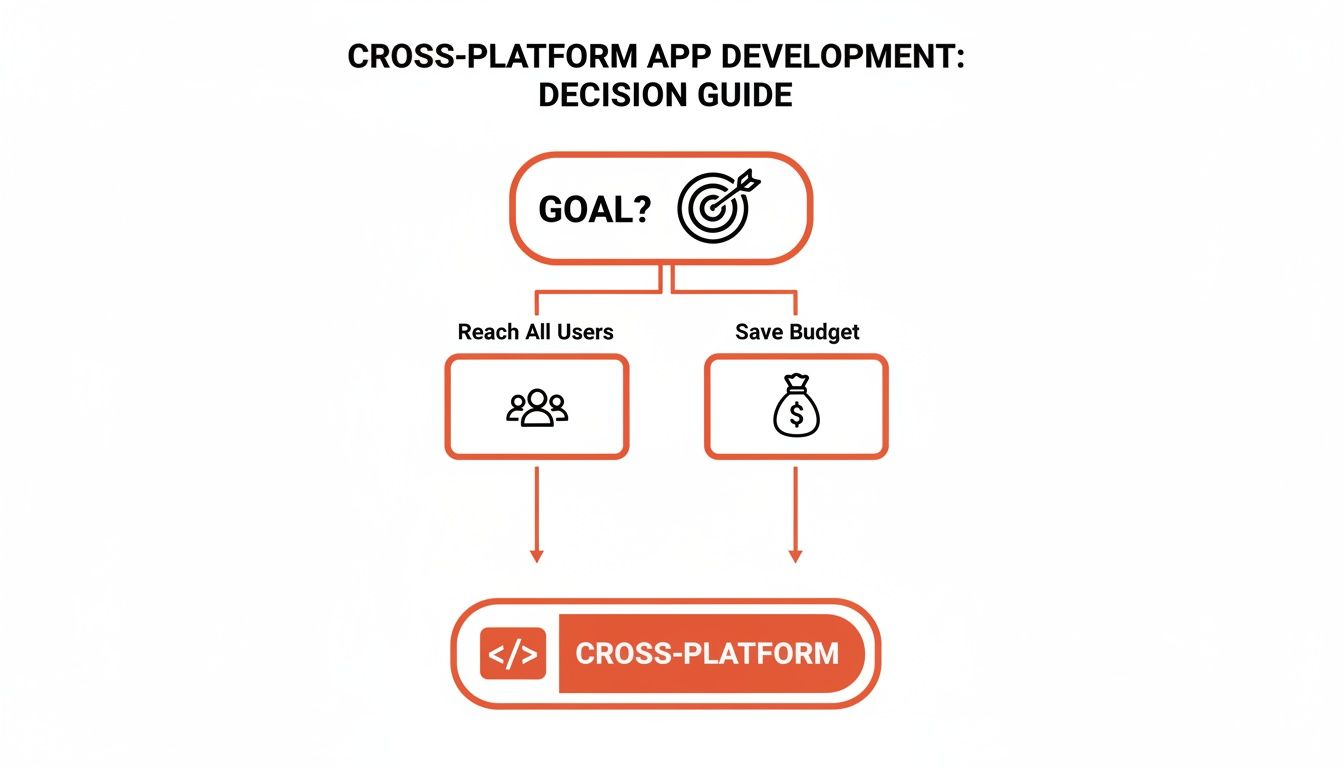
As the visual guide suggests, if your primary goals are to reach all your customers and manage your budget effectively, the path naturally leads to cross-platform app dev.
To make this choice clearer, let's compare the two approaches from a business owner's perspective.
Native vs Cross-Platform: A Quick Comparison for Business Owners
This table cuts through the technical jargon to show you what really matters when you're deciding where to invest your resources.
Factor | Native Development (e.g., Swift for iOS, Kotlin for Android) | Cross-Platform Development (e.g., Flutter, React Native) |
|---|---|---|
Initial Cost & Time | High. Requires two separate teams and codebases. | Lower. One team, one codebase. Faster to market. |
User Reach | Limited. Targets only one platform (iOS or Android). | Broad. Reaches users on both platforms simultaneously. |
Performance | Highest. Optimised for a single OS. Ideal for intensive apps. | Excellent. Near-native performance for most business apps. |
User Experience (UX) | Seamless. Follows platform-specific design guidelines perfectly. | Consistent. A uniform look and feel across both platforms. |
Long-Term Maintenance | Expensive. Updates and bug fixes needed for two separate apps. | Efficient. Update the shared codebase once for both platforms. |
Access to Device Features | Immediate. Full access to the latest OS-specific features. | Very Good. Accesses most features (camera, GPS) with ease. |
Ultimately, while native offers peak performance for highly specialized apps, cross-platform provides a strategic balance of cost, speed, and reach that is the perfect fit for most SMEs.
Performance and User Experience Trade-Offs
A common concern for business owners is whether a cross-platform app will feel "cheap" or sluggish. A few years ago, that was a valid worry. Today, the technology has advanced so much that this is no longer a real issue for most businesses.
While a native app might have a slight edge for graphically intense games or augmented reality, the difference is now negligible for 95% of business applications. For e-commerce, booking systems, or internal tools, your users won't be able to tell the difference.
Actionable Takeaway: Before committing, identify the single most critical function of your app. Is it a fast checkout? A smooth booking calendar? Focus your development partner on perfecting that one experience. For almost all business use cases, modern cross-platform frameworks deliver a premium feel without the premium price tag.
Cost and Long-Term Maintenance
This is where cross-platform development truly shines for SMEs. Building two native apps means hiring two specialist development teams. This doubles your initial investment and your ongoing maintenance costs. Many SME owners worry about this hidden cost, but cross-platform directly addresses it.
Here’s a rough idea of the savings:
Initial Build: A cross-platform approach can be around 30-40% cheaper than building two native apps from scratch.
Maintenance: When you need to add a feature or fix a bug, you only pay for it once. This makes long-term costs predictable and manageable.
When weighing your options, it's helpful to understand the full scope of what you're comparing against. Getting familiar with the key considerations for native Android app development can provide a clearer picture of the costs and complexities involved. For many businesses, the conversation around cost also leads to another highly efficient approach, which you can explore in our guide on the benefits of low-code and no-code platforms.
Can It Handle Complex Features?
Another outdated myth is that cross-platform apps can't handle complex functionality. Modern frameworks like React Native and Flutter have extensive libraries that allow them to access native device features, including:
Camera and photo gallery
GPS and location services
Bluetooth connectivity
Push notifications
Biometric authentication (Face ID, fingerprint)
Unless your app's core function relies on a brand-new, OS-specific feature (like Apple's latest ARKit update that just rolled out), a cross-platform solution is more than capable of delivering what you need.
Exploring Top Frameworks Like Flutter and React Native
Once you've decided that a cross-platform approach is right for your business, the next question is, "Which tool should we use?" Think of this as choosing the construction materials for your new building. Your choice will impact your budget, timeline, and the final product.
The world of cross-platform app dev is dominated by two main players: Flutter and React Native. Understanding them isn't about the code; it's about the business implications.
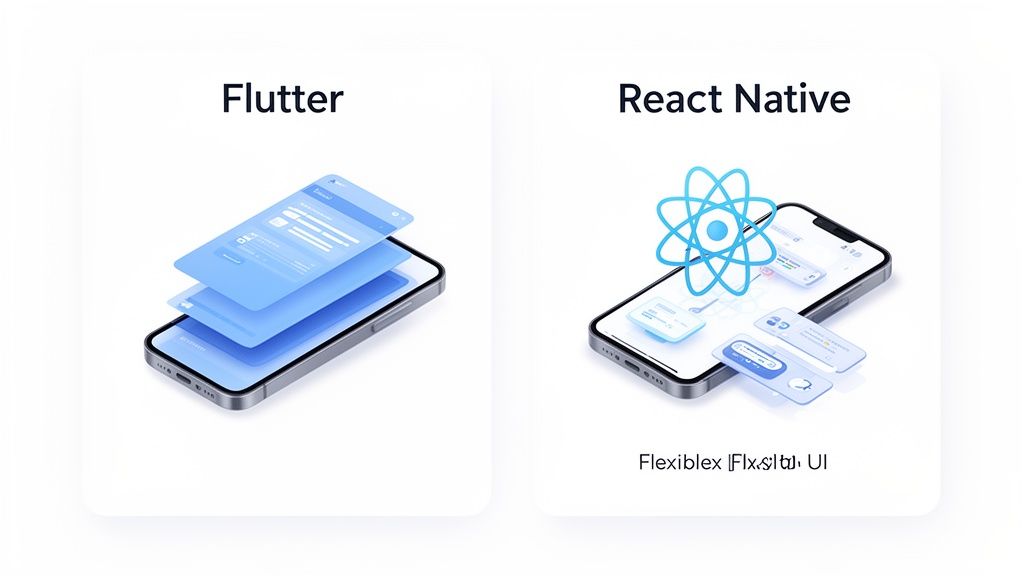
Flutter: For a Premium, Consistent Brand Experience
Developed by Google, Flutter is a favorite for businesses that want a beautiful, highly-branded user experience that is identical on every device.
Think of Flutter as a high-end prefabricated building system. It comes with its own set of quality components (called widgets) and renders them itself. This means it doesn’t rely on the standard building blocks of iOS or Android.
The business result is pixel-perfect consistency. Your app will look and behave exactly the same on an iPhone as it does on a Samsung device. This is fantastic for reinforcing your brand identity and delivering a polished, high-performance feel with smooth animations.
Real-World Use Case: A luxury e-commerce brand in Belgium wants its app to reflect its premium image. Using Flutter, they can create a unique, custom-designed interface that stands out from competitors and works flawlessly on all devices, leading to higher customer satisfaction and brand loyalty.
React Native: For Leveraging Web Skills and Faster Development
Created by Facebook (now Meta), React Native takes a different path. It allows developers to build mobile apps using JavaScript and React—the same technologies used to build most modern websites.
This is a huge advantage for businesses. The pool of developers who know JavaScript is massive, making it easier and often more cost-effective to find talent. React Native acts as a "bridge," translating the code into the native user interface components of each phone. This means your app uses the official buttons and menus of iOS and Android, helping it feel "at home" on each platform.
Real-World Use Case: A SaaS startup needs to build an app quickly to complement its web platform. Their existing web developers can use their JavaScript skills to build the mobile app with React Native, significantly reducing the time to market and development costs.
Other Notable Frameworks
While Flutter and React Native are the leaders, it's worth knowing about other options:
Xamarin (now .NET MAUI): Backed by Microsoft, this is a strong choice for businesses already heavily invested in the Microsoft ecosystem. It's popular in enterprise environments.
Ionic: This framework uses web technologies (HTML, CSS, JavaScript) and is great for simpler apps or for turning an existing website into a mobile app with minimal effort.
Making the Right Business Decision
So, how do you choose? It comes down to your business priorities.
Choose Flutter if your top priority is a highly polished, custom-branded user interface with smooth animations that looks identical everywhere.
Choose React Native if you want to tap into a vast talent pool, potentially reuse existing web development resources, and ensure your app uses the standard native UI of each platform.
Actionable Takeaway: When speaking with potential development partners, ask them which framework they would recommend for your specific project and why. A good partner will explain their choice based on your business goals, not just their technical preference. For instance, if you plan to gather extensive customer feedback through in-app forms, ensure the chosen framework integrates easily with a tool like Weavely.ai, which can help you create intelligent, AI-powered surveys to better understand your users.
Your Roadmap to Building a Cross-Platform App
Building a cross-platform app is a manageable process when broken down into clear steps. This isn't a technical manual; it’s a business-focused guide to help you build an asset that delivers real value.
Step 1: Define Your Core Purpose (The Problem You Solve)
Before writing a single line of code, answer one question: What problem does my app solve for my customer? A great app has a clear purpose. Is it to make booking appointments easier? To provide faster access to product information? To streamline a workflow for your team?
Actionable Next Step: Write down a single sentence that starts with "My app helps [target customer] to [achieve a specific goal] by [solving a specific problem]." This sentence will be your guide for every decision that follows.
Step 2: Create a Lean Feature List (Your MVP)
It’s tempting to want an app that does everything. But successful apps start small with a Minimum Viable Product (MVP). An MVP is the simplest version of your app that solves the core problem you identified in Step 1.
Real-World Use Case (Professional Services): A consulting business wants an app to improve client engagement. Their MVP could simply be a booking system and a list of services. A client portal with document sharing can be added in a later version based on user feedback.
Starting with an MVP gets your app to market faster, keeps initial costs down, and lets you gather real customer data before you invest more.
Step 3: Choose the Right Development Partner
Unless you have an in-house team, you'll need a partner to build your app. This is a critical decision. Look for a team that understands your business goals, not just the technology.
A good partner will ask about your target audience, your revenue model, and your long-term vision. They should act as a strategic guide, helping you make smart decisions that align with your budget and goals.
Step 4: Navigate Design and Development
Once you’ve found your partner, the work of designing and building begins.
First is UX/UI design, the blueprint for your app. It dictates how it looks, feels, and functions. A brilliant user experience is non-negotiable; as you can read in our guide on the fundamentals of UX/UI design, it’s what turns a functional app into one people love to use.
With the design set, development begins. Your partner will likely work in "sprints," building out features in short, focused cycles. You should receive regular updates and have opportunities to provide feedback.
Step 5: Test, Launch, and Iterate
Before going live, the app must be thoroughly tested on various devices to find and fix any bugs. This Quality Assurance (QA) phase ensures your first users have a smooth experience.
After testing, your app is submitted to the Apple App Store and Google Play Store. Once approved, you're live! But the work doesn’t stop there. Launching is just the beginning. Now you can use user feedback and analytics to plan updates, add new features, and continuously improve the app's value. As you plan your next moves, it's always a good idea to look at examples of mobile application projects to see what's possible and get inspired.
Success Stories from Belgian Businesses
Theory is one thing, but seeing how other businesses like yours have made cross-platform app dev work is where it really clicks. This approach isn't just for global tech giants; it's a practical, results-driven strategy that Belgian SMEs are using to grow, innovate, and get ahead.
Let's look at a few real-world examples of how this technology translates into tangible business results, right here in Belgium. These stories show how a single, smart investment in a cross-platform app can become a powerful engine for growth.
The Antwerp Retailer Boosting Sales
An independent fashion retailer in Antwerp struggled to compete with large online stores. Their website was functional, but lacked the smooth, engaging mobile experience that drives sales. They invested in a cross-platform e-commerce app built with Flutter.
The goal was simple: create a beautiful, fast shopping experience for both iPhone and Android customers. By building one app, they cut their initial development costs by an estimated 30% and launched just in time for the peak shopping season.
The Result (The ROI): The app was a huge success. With features like push notifications for new arrivals and a seamless checkout, they saw a 25% lift in repeat purchases within the first six months. The app became their most valuable sales channel, proving that SMEs can deliver a world-class mobile experience without a massive budget.
The Brussels Non-Profit Driving Engagement
A non-profit organisation based in Brussels needed a better way to connect with its volunteers and community. Communication was fragmented across email, social media, and their website, making it hard to coordinate events.
They used a cross-platform approach to build a simple community hub app. It included an events calendar, a news feed, and a volunteer sign-up form. This allowed them to reach their entire audience at once, regardless of their device.
The Result (The ROI): By centralizing communications, the non-profit made it effortless for people to participate. This led to a 40% increase in volunteer sign-ups for local events, directly impacting their mission.
This model of enabling seamless access across devices isn't just for customers; it's a strategy Belgian SMEs are adopting for internal tools as well. Major corporations have shown the way; for example, Unilever's "My Unilever" app was built to give over 53,000 factory colleagues easy access to company resources on any device. You can explore more about the growing trend of cross-platform business apps in Europe.
The Ghent Startup Securing Funding
For a tech startup in Ghent, speed was everything. They had a brilliant idea but needed a working prototype—a Minimum Viable Product (MVP)—to show investors. Building two separate native apps would have been too slow and expensive.
Using React Native, they developed a functional MVP in less than three months. This single app worked flawlessly on both iOS and Android, allowing them to demonstrate their concept to the entire market.
The Outcome (The ROI): The professional MVP was a key factor in their successful seed funding round. They secured the capital needed to grow their team and develop more features, turning their idea into a viable business much faster than their competitors.
How to Start Your App Development Journey
Feeling inspired to build an app but unsure where to begin? Let's turn that energy into a clear, actionable plan. Kicking off your cross-platform app dev journey is less about technology and more about getting your business strategy right from day one.
The key takeaway is this: for Belgian SMEs, cross-platform development is the smartest, fastest, and most cost-effective way to get your business onto your customers' phones. You reach everyone on both iOS and Android simultaneously, without a double-sized budget or an endless timeline.
Your Simple Path Forward: Next Steps
Ready to turn your idea into a real, working app? Here are the immediate, practical steps you can take.
Clarify the Business Problem: Before anything else, clearly define the single biggest problem your app will solve. Is it to simplify bookings for clients? Or streamline internal workflows for your team? A crystal-clear purpose is the foundation of a successful app.
Book a Complimentary Strategy Call: You don’t have to figure this out alone. The best next step is to talk with experts who understand both the business and technical sides of app development. A no-obligation strategy session can validate your idea, clarify your budget, and show you what’s possible.
Define Your MVP and Roadmap: Work with a development partner to map out a project scope that fits your budget. This means defining the essential features for a Minimum Viable Product (MVP) and creating a clear roadmap for the build, the launch, and future improvements.
The goal isn't just to build an app—it's to build a business asset that engages customers, streamlines operations, and drives measurable growth.
Finding the right team is the most critical part of the process. If you’re looking for a partner to guide you, our team is here to help. As a leading software development company in Belgium, we specialize in turning business visions into high-performing cross-platform applications.
Ready to see how a custom app could drive real ROI for your business?
Book a complimentary strategy call with our team today. Let's talk through your vision and build a clear roadmap to bring it to life.
Frequently Asked Questions
Still considering your options? Here are straightforward answers to the questions we hear most from business owners about cross-platform app development.
How Much Does a Cross-Platform App Cost?
While every project is different, the main takeaway is savings. A cross-platform approach can reduce your initial investment by 30-40% compared to building two separate native apps. For a typical SME business app, this often means saving thousands of Euros that can be reinvested into marketing or other areas of your business.
Will My App Look and Feel the Same on iPhone and Android?
Yes, and that’s a major business advantage. Modern frameworks like Flutter are excellent at creating a consistent, high-quality user experience on every device. Your branding, colors, and layout will look and feel the same everywhere, which is crucial for building a strong, recognizable brand. To the average user, a well-built cross-platform app is indistinguishable from a native one.
How Long Does It Take to Build a Cross-Platform App?
Speed is a key benefit that directly impacts your ROI. Because you're working from a single codebase, the development timeline can often be 40-50% shorter than a native build. A straightforward app for an SME can often go from idea to launch in just a few months, allowing you to start generating revenue and gathering customer feedback much faster.
A quicker launch means you start generating a return on your investment sooner. For a growing business, that speed can be a serious competitive edge.
Is Cross-Platform Powerful Enough for My App Idea?
For the vast majority of business app ideas, the answer is a resounding yes. Today's frameworks can handle almost anything, including accessing the phone’s camera, using GPS for location services, sending push notifications, and creating complex animations. Unless your app relies on highly specialized, cutting-edge hardware features (like advanced augmented reality), a cross-platform solution is more than powerful enough to deliver a fast, reliable, and feature-rich experience.
