A Guide to Using a Trade Bot Crypto for Business Growth
Discover how a trade bot crypto can automate trading, manage digital assets, and drive ROI. A practical guide for SMEs on strategies, risks, and selection.
Jan 9, 2026

Think of a crypto trading bot as your company’s new financial analyst—one that works 24/7 without ever needing a coffee break. It's not just for Wall Street traders anymore; it's a smart piece of software that automatically buys and sells digital assets based on rules you set, working tirelessly to spot opportunities you might otherwise miss.
What Is a Crypto Trading bot and Why Should Your Business Care?

At its heart, a crypto trading bot is a program you instruct to manage your company's digital assets. Instead of you or your finance team being glued to screens watching the notoriously volatile crypto markets, you define the strategy. For example, you can tell it to "buy Bitcoin if the price drops by 5% in an hour and sell if it rises by 7%." The bot then links to your company’s crypto exchange account (like Kraken or Binance) and executes these commands instantly, day or night.
For a small or medium-sized business, this isn’t some far-off tech fantasy. It's a practical tool for improving efficiency and unlocking new revenue, turning crypto from a speculative gamble into a managed corporate asset.
From Complex Concept to Practical Tool
The real magic for a business owner is the automation. Many entrepreneurs are interested in digital assets but simply don't have the hours to actively manage them. A trade bot crypto solves this by putting your strategy on autopilot. This becomes incredibly useful for businesses in various sectors:
E-commerce: A Ghent-based online store accepts payments in Ethereum. They can use a bot to instantly convert that ETH into a stablecoin (like USDC), protecting their revenue from sudden price drops before it even hits their bank account.
Professional Services: A SaaS company in Antwerp holds some Bitcoin on its balance sheet from an early investment. Instead of letting it sit idle, they could deploy a low-risk bot to generate a small, steady return on those assets, improving their treasury management.
Actionable Takeaway: Start small. If you accept crypto, set up a simple "convert-to-stablecoin" rule on a platform like 3Commas or Pionex. This is a low-risk first step that immediately protects your revenue from volatility.
It's a common myth that you need to be a coding whiz to use a trading bot. These days, many platforms are built for business owners, with simple, visual interfaces that feel more like setting up a new email campaign than writing software.
A Rapidly Growing Market Opportunity
This shift toward automation isn't a niche trend. The global AI crypto trading bot market is already valued at an estimated USD 40.8 billion and is projected to hit a staggering USD 985.2 billion by 2034. That’s a compound annual growth rate of 37.6%—a clear signal that businesses are taking this seriously. Europe is a key growth hub in this space. To get a real sense of the scale, you can explore more market outlook data on this topic.
Ultimately, a trade bot crypto isn't about getting rich quick. It's about applying the same smart principles of automation you already use in your business—like with your CRM or accounting software—to your digital assets to improve your bottom line.
How a Trading Bot Actually Executes a Trade
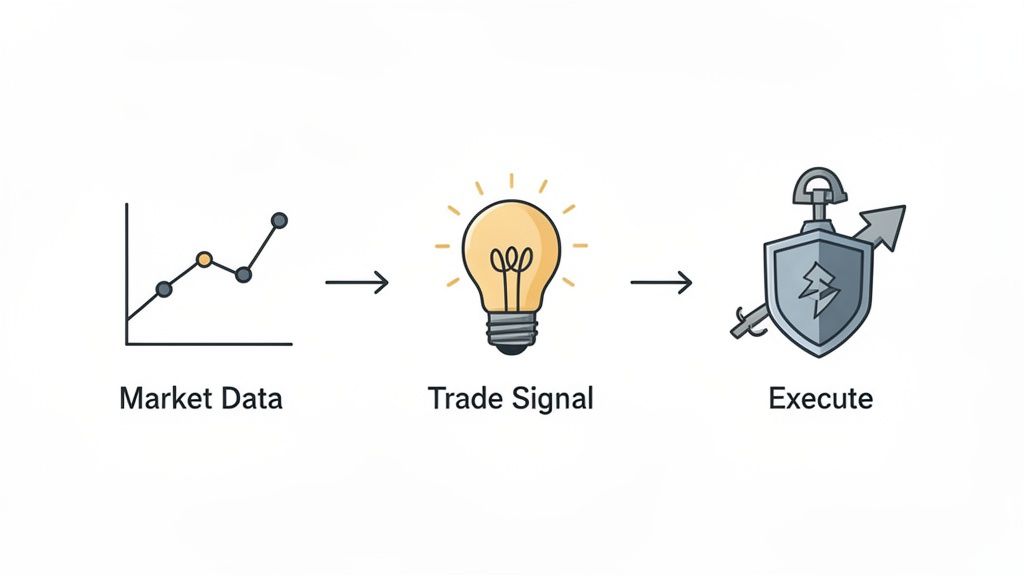
Let's look under the hood, without getting buried in technical jargon. A trade bot crypto solution isn’t black magic; it follows a clear, logical process that any business owner can understand.
Think of it like an automated inventory system for your webshop. It constantly watches your sales data, flags when a popular product is running low (a "buy" signal), and automatically places a reorder with your supplier (execution). A trading bot does the same thing, just with digital assets instead of physical stock.
This entire process boils down to three core steps.
The Three Pillars of an Automated Trade
Data Analysis (The Watcher): The bot is constantly plugged into crypto exchanges, pulling in a massive stream of market data—price movements, trading volumes, and order book information.
Signal Generation (The Brain): Based on the rules you’ve set, the bot analyzes this data to spot opportunities. This is its 'brain', deciding when the conditions are just right. Your rule might be, "If Bitcoin's price crosses its 50-day moving average, generate a 'buy' signal." This is where your strategy comes to life.
Order Execution (The Doer): The moment a signal is generated, the bot acts instantly. It sends a command to the exchange to either buy or sell the asset at the best possible price. The speed here is a massive advantage; a bot can execute a trade in milliseconds, far faster than any human possibly could.
To bring this to life, let's break down these core parts into a business analogy. Think of the bot as a highly efficient, automated department within your company.
Core Components of a Crypto Trading Bot
Component | Business Analogy | Function in Trading |
|---|---|---|
Data Analysis | Market Research Team | Continuously gathers and processes real-time market data from various exchanges. |
Signal Generation | Strategy Department | Applies pre-set rules and algorithms to the data to identify trading opportunities. |
Order Execution | Operations Team | Places buy and sell orders on the exchange instantly when a signal is confirmed. |
Risk Management | Compliance Officer | Enforces rules like stop-loss and take-profit to protect capital and manage exposure. |
Each part works together seamlessly to execute your trading strategy around the clock, without emotion or fatigue, directly impacting your ROI.
How Your Bot Talks to the Exchange
A common question business owners have is, "How can a piece of software even access my company's exchange account? Is that secure?" This is where an Application Programming Interface (API) comes in.
An API is simply a secure messenger. You generate a special set of "API keys" from your exchange account (like Binance or Kraken) and give them to your bot. These keys act as a limited-access pass, allowing the bot to place trades on your behalf without ever needing your login details.
Actionable Takeaway: When setting up your API keys, you can—and absolutely should—disable withdrawal permissions. This is a non-negotiable security step. It means that even in the unlikely event your bot's security is breached, no one can move funds out of your exchange account.
The ‘brain’ behind all this is an algorithm—just a fancy word for a set of instructions. A simple algorithm might follow a basic checklist. However, newer AI-powered bots don't just follow static rules; they learn from market behavior, adapting their strategy over time to improve performance. The core components of this operation often rely on powerful infrastructure. Understanding the basics of how cloud computing solutions support these data-heavy tasks can provide valuable context for how these systems operate at scale.
Practical Trading Strategies Your Business Can Automate
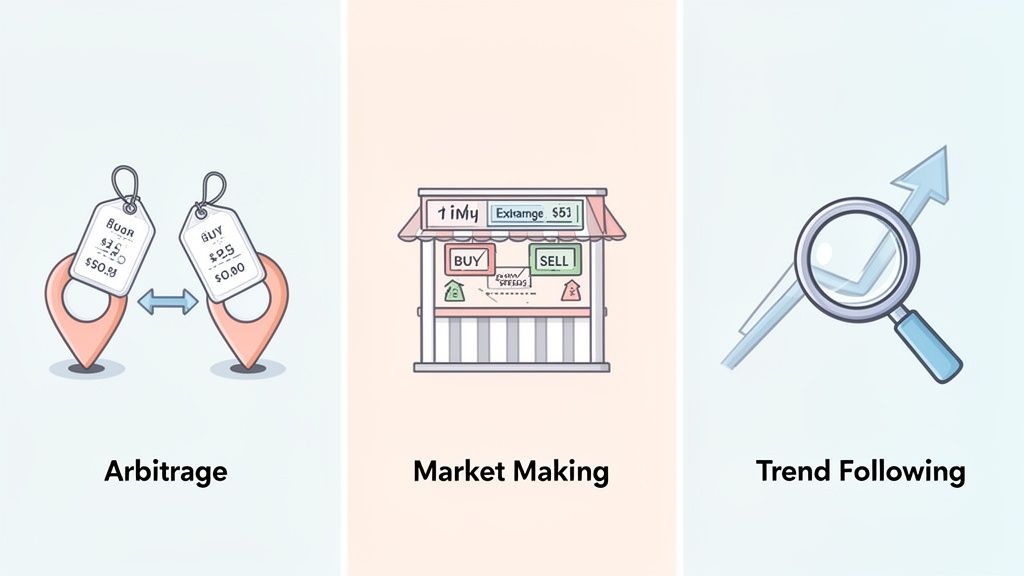
Knowing how a bot works is one thing, but putting it to work for your business is where the real value lies. The power of these tools is their ability to execute proven strategies with perfect discipline and speed, 24/7. Let's look at three surprisingly straightforward strategies any business can use to turn dormant digital assets into active, revenue-generating tools.
These aren't about high-risk gambles; they're about applying solid business principles—like spotting price differences or managing supply and demand—to the crypto markets.
The Arbitrage Strategy
Imagine you run an online shop and find a supplier in Germany selling a gadget for €10. At the same time, you notice customers in France are happily buying it for €12. Arbitrage is the simple act of buying from the German supplier and instantly selling to the French customer to pocket the €2 difference.
A crypto trading bot does the exact same thing, just at light speed. It constantly scans prices for the same digital asset, like Bitcoin, across different exchanges.
Real-World Example: Your bot spots Bitcoin trading for €60,000 on Exchange A but €60,150 on Exchange B. In a fraction of a second, it buys on A and sells on B, capturing that €150 price gap before a human trader could even react. For a business, this is a relatively low-risk way to generate small, frequent profits on capital that might otherwise be sitting idle.
The Market Making Strategy
Think of the currency exchange booth at an airport. It makes money by offering to both buy and sell currencies, earning a tiny margin on every transaction—the difference between the 'bid' (their buy price) and the 'ask' (their sell price). A market-making bot does precisely this for a specific crypto asset.
Your bot places simultaneous buy and sell orders around the current market price, effectively creating its own mini-marketplace.
This strategy provides liquidity to the market, which is just a fancy way of saying it makes trading easier for everyone else. In return for providing this service, your bot earns the "spread" on every trade that gets filled.
Business Use Case: A SaaS company holds a fair amount of Ethereum from international customer payments. Instead of letting it sit there, they deploy a market-making bot. The bot continuously places buy orders slightly below the market price and sell orders slightly above, generating a steady, passive income stream from their existing crypto holdings. This can directly improve the ROI on their corporate treasury.
The Trend Following Strategy
Any savvy business owner knows when a product is catching on. You see sales rising and positive customer feedback pouring in, so you increase your inventory to ride that wave of momentum. Trend following in trading works on the exact same principle.
A trend-following bot is programmed to identify the direction the market is heading—up or down—and trade with it. It uses technical indicators, like moving averages, to determine when a strong trend has formed. The goal isn’t to time the top or bottom perfectly, but to capture the biggest slice of a major market move.
Ideal Conditions: This approach works best in markets that show clear, sustained directional movements. It’s less effective in markets that are just moving sideways with no clear direction. For businesses looking for a more hands-off, long-term growth strategy for their crypto assets, trend following can be an excellent fit. As with any strategic move, businesses exploring this level of automation often work with an expert; you can learn more about how a specialised artificial intelligence automation agency can help design and implement these systems.
Balancing the Real Benefits and Business Risks
Jumping into any new technology requires a clear-eyed look at the pros and cons, and a trade bot crypto solution is no different. The upsides are compelling, but it's vital to weigh them against the potential risks before you commit company capital.
For a busy entrepreneur, the benefits are immediate. A bot is your tireless employee, operating 24/7 across global markets while you sleep. It executes your strategy with pure logic, removing the emotional rollercoaster of fear and greed that trips up even seasoned traders. Plus, its ability to execute trades in milliseconds gives you a speed advantage that’s impossible for a human to match.
The Undeniable Upsides of Automation
For SMEs, the real advantages go beyond just placing orders. They represent a move toward smarter operational efficiency and strategic asset management, which can directly boost your bottom line.
Non-Stop Market Coverage: The crypto market never closes. A bot ensures you never miss a prime opportunity, no matter what time zone it happens in.
Emotion-Free Execution: Bots stick to the plan. They trade based on pre-set logic, sidestepping impulsive decisions driven by market hype or panic.
Enhanced Speed and Accuracy: In a market where prices swing wildly in seconds, a bot's ability to analyze data and place orders instantly is a huge competitive edge.
Strategic Discipline: Your bot enforces your trading strategy with perfect consistency, helping you stick to your long-term financial goals.
Navigating the Real-World Risks
Now for the other side of the coin. Every business owner needs to think about the risks. These aren't red flags telling you to stay away, but rather factors to manage with solid planning.
A major concern for SMEs is complexity and cost. Does this require a huge time investment? Will it break the bank? While a custom-built bot can be expensive, many user-friendly platforms like CryptoHopper offer affordable monthly subscriptions. The initial setup might take a few hours, but once it's running, the time investment is minimal—mostly just periodic check-ins.
Market risks are another big consideration. Sudden price crashes can trigger your bot to sell at a loss if your strategy isn't built to handle extreme volatility. This is why starting small and testing is so crucial.
"I don't have time to learn a complex new tool." This is a common and valid concern. Frame this as an investment in efficiency. You invested time to learn your accounting software to save hours on bookkeeping; a trading bot is the same principle applied to your digital assets. The ROI comes from automation freeing up your time.
Benefits vs Risks: A Balanced View for SMEs
To make sense of it all, it helps to see the upsides and downsides side-by-side. While the risks are real, they are almost always manageable with the right approach.
Benefit (The Upside) | Risk (The Downside) | How to Mitigate the Risk |
|---|---|---|
24/7 Unattended Trading | Technical Failures (server downtime, bugs) | Choose reputable bot platforms; start with a small amount of capital to test reliability. |
Emotionless, Logical Decisions | Flawed Strategy Execution (a bad strategy is executed perfectly) | Backtest strategies rigorously; review and adjust parameters based on performance. |
Millisecond Execution Speed | Slippage (price changes between order and execution) | Use limit orders instead of market orders; trade on high-liquidity exchanges. |
Handles Multiple Markets | API Key Security Breach | Set API permissions to "trade only" (no withdrawal); use strong, unique keys. |
Systematic Strategy Testing | Over-Optimisation (strategy works on past data but fails live) | Test on out-of-sample data; keep the strategy simple and robust. |
Ultimately, a well-managed trading bot shifts the odds in your favour by imposing discipline and exploiting opportunities that are impossible to catch manually.
Mitigating Risks in a Regulated Environment
Fortunately, the regulatory landscape is maturing, which helps reduce some of the operational guesswork. In Belgium, for instance, interest in automated crypto trading has grown alongside the country’s steady crypto adoption. According to a recent report, Belgium scores 77 on the Crypto Adoption Index and an impressive 80 on the Regulatory Readiness Index, placing it in the upper tier of European markets.
Higher regulatory readiness means clearer rules on compliance, creating a safer environment for businesses. Finally, don’t forget about taxes. As your bot starts generating profits, managing the tax implications is crucial. To get a handle on this, consider exploring a crypto tax software comparison guide to find tools that can automate your record-keeping and simplify compliance.
How to Choose the Right Trading Bot for Your Company
Picking the right trading bot is a critical business move. The best tool is the one that fits your company’s goals, technical comfort level, and the time you can realistically commit. Getting this choice right saves headaches and capital down the line.
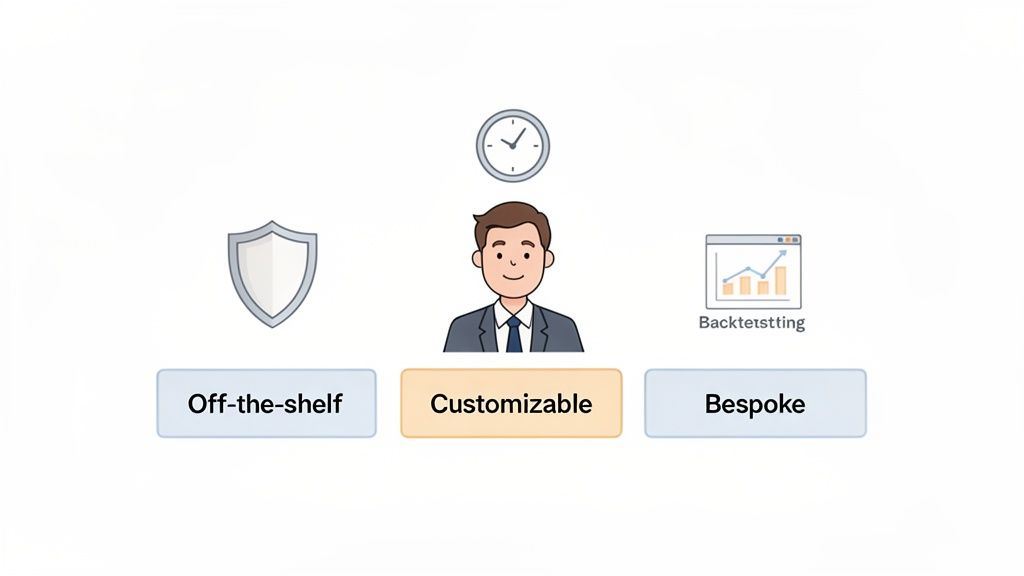
Your options generally fall into three buckets: user-friendly 'off-the-shelf' platforms, more flexible customisable bots, and fully bespoke solutions for specific needs.
Your Three Main Options Explained
1. Off-the-Shelf Platforms Think of these as the Shopify of the trading bot world. They're designed for ease of use, with pre-built strategies and intuitive dashboards. A business owner could get one running in under an hour without writing any code. Tools like Pionex and 3Commas are popular choices here.
2. Customisable Bots These platforms offer a middle ground. They provide a framework but let you tweak strategies or build your own rules through a simple interface. For example, if you gather specific market sentiment data through customer surveys—perhaps using a tool like Weavely.ai to quickly build and deploy forms—you could create custom rules based on that unique insight. You can also learn more about how low-code and no-code platforms make this accessible.
3. Bespoke Solutions This is the full-service option: hiring developers to build a trading bot from the ground up. It offers maximum control but also comes with the highest cost and complexity, usually reserved for larger firms.
Key Criteria for Your Evaluation
Before you sign up, do your homework. Treat this like choosing any other mission-critical software. For a deeper dive, exploring comprehensive guides on the best automated crypto trading bots can give you valuable comparative insights.
Your evaluation checklist should include these non-negotiables:
Security Protocols: How do they protect your API keys? Is there a public track record of security incidents? Look for features like two-factor authentication (2FA) and IP whitelisting.
Exchange Compatibility: Does the bot work with the crypto exchanges your business already uses, like Kraken or Binance?
Reliability and Uptime: A bot is useless if it’s constantly offline. Check reviews and community forums for honest feedback on the platform’s stability.
Customer Support: When something goes wrong, can you get help from a real person quickly? Good support is often the sign of a professional operation.
The Non-Negotiable Step: Backtesting
Perhaps the most crucial step is backtesting. This is where you use historical market data to simulate how your chosen strategy would have performed in the past. It’s like test-driving a car before you buy it.
A reputable bot platform will have a robust backtesting feature built-in. If it doesn't, that's a massive red flag. Never commit real capital to a strategy you haven't thoroughly vetted against historical data.
This process helps you spot flaws in your logic and fine-tune your approach without risking a single euro. It forces your decisions to be based on data, not just slick marketing promises.
Actionable Next Step: Choose one of the strategies mentioned earlier (e.g., Arbitrage). Sign up for a free trial on a platform that offers backtesting. Run a simulation of that strategy over the last six months of market data. This costs you nothing but will give you a real, data-backed feel for how automated trading works.
Understanding Belgian and EU Crypto Regulations
If you're running a crypto trading bot from Belgium, you're operating within a European regulatory scene that’s getting clearer every day. Think of it less as a hurdle and more as a safety net that creates a stable, predictable environment where your business can grow with confidence.
The MiCA Regulation Explained
The big one to know is the Markets in Crypto-Assets (MiCA) regulation. This is a landmark law that creates a single, harmonized set of rules for crypto service providers across the EU, including Belgium.
What does this mean for your business? MiCA brings in clear rules on transparency and investor protection. It means crypto exchanges and wallet providers have to be properly authorized and supervised, which massively reduces the risk of you working with a dodgy platform.
For a business using a trading bot, MiCA is great news. It means the exchanges your bot connects to are held to a much higher standard of security and professionalism, which directly reduces your operational risk.
AML and KYC: Your Responsibilities
You'll also hear the acronyms AML (Anti-Money Laundering) and KYC (Know Your Customer). These are standard compliance checks that any legitimate financial service, including crypto exchanges, must follow.
When you set up a corporate account on an exchange, you’ll be asked to provide documents to prove your business is legitimate. That's KYC. It's no different from opening a business bank account and is a non-negotiable part of operating in a regulated market.
Navigating Belgian Crypto Tax
From a tax perspective, any profits your crypto trading bot makes are typically classed as business income in Belgium and will be taxed accordingly. The single most important takeaway here is the need for meticulous record-keeping.
Every single trade your bot executes is a taxable event you need to log. This includes:
The date and time of the trade.
The type and amount of crypto bought or sold.
The transaction’s value in Euros at the time it happened.
Any fees paid to the exchange.
Trying to track thousands of bot trades manually is impossible. This is where automated crypto tax software becomes a lifesaver, linking with your exchange accounts to produce a detailed, audit-proof record.
Belgium’s position within the European Economic Area (EEA) also influences how local firms can use these bots. Market analysis shows that the EEA sees a lot of "bridge" transactions—moving assets between different blockchains. You can discover further insights into European crypto adoption to learn more. This is relevant for Belgian businesses, as many modern bots are now built to use automated bridging and stablecoin strategies. As always, chat with a Belgian tax advisor to ensure your reporting is compliant with the latest rules.
Your Crypto Trading Bot Questions Answered
Diving into any new technology is bound to stir up questions. When it comes to using a trade bot crypto solution, you need clear, straightforward answers to feel confident. Here are some of the most common queries from business owners.
How Much Capital Do I Need to Start?
You don't need a massive investment. Many bot strategies can be tested with just a few hundred to a few thousand euros. The smart approach is to treat this like a pilot project.
Actionable Takeaway: Start with a small amount of capital you are genuinely prepared to lose. This lets you see how the bot performs in live markets without putting your business at risk. Once you’re confident in the results, you can consider increasing your allocation. This approach minimizes risk while maximizing learning.
Is It Complicated to Set Up a Trading Bot?
It depends on the path you choose, but modern platforms are built for business users, not just developers. Many have intuitive dashboards that make the setup process surprisingly simple.
For most off-the-shelf bots, the process is:
Create an account on the bot platform.
Securely connect it to your crypto exchange using an API key (with withdrawals disabled).
Choose a pre-built strategy or set your own simple rules.
You can often get this done in less than an hour. While building a custom bot is technical, most businesses will find that ready-made solutions offer the best mix of efficiency and results.
Can a Crypto Bot Guarantee Profits?
No. This is the most critical takeaway for any business owner. No tool can guarantee profits in a volatile market. A trading bot is an instrument for executing a strategy with discipline and speed—it is not a crystal ball.
Be extremely wary of any service that promises guaranteed returns. This is a universal red flag in the financial world. A bot's success depends entirely on the quality of your strategy and the market conditions. Its purpose is to improve your ROI potential, not eliminate risk.
How Do I Keep My Funds Safe When Using a Bot?
Security has to be your number one priority. First, only use well-established exchanges and bot platforms with a strong track record. Research them just as you would any other critical software vendor.
Second, always enable two-factor authentication (2FA) on every single account—both the exchange and the bot platform.
Third, and most importantly, when you create the API keys to connect the bot, grant it permission to trade but never to withdraw funds. This simple step ensures that even if your API key were somehow compromised, your assets could not be moved out of your exchange account.
