Finding Great Social Media Marketing Agencies for Your Business
Struggling to find the right partner? This guide unpacks how to find, vet, and collaborate with top social media marketing agencies that drive real growth.
Jan 20, 2026
Social media marketing agencies are specialized teams that handle everything from your content and community management to your ad campaigns. Think of them as your outsourced social media department. The whole point is to free you up to actually run your business, knowing that a crew of experts is dedicated to growing your brand, finding new leads, and driving sales online.
Knowing When You Need an Agency Partner
Ever feel like you’re just posting into the void? You’re active on social media, you’re engaging with comments, maybe even boosting a few posts, but the needle just isn't moving. Forget the obvious "I have no time" excuse for a moment. Let's dig into the real business signals that are screaming for expert help.
Bringing in an agency is a big decision, and it’s natural to worry about the cost ("Can I really afford this?") or feel like you’re losing control ("Will they get my brand's voice right?"). But it helps to reframe it: you’re not just adding an expense. You're making a strategic investment in specialized talent that can deliver a measurable return on investment (ROI).
Key Signs You've Outgrown In-House Efforts
Realizing you need professional help isn't a failure—it's a sign of growth. Your business might be sending some pretty clear signals that it's time to bring in the pros.
Here are the most common tells:
Your Growth Has Flatlined: Your follower count, engagement rates, and the traffic you get from social channels have all hit a plateau and stayed there for months. The tactics that used to work have lost their magic, and you’re fresh out of ideas to get things moving again.
You Can't Scale What's Working: So, you had a post go mini-viral or a campaign that did really well. Great! But now what? If you don't have the strategy or resources to replicate that success consistently, it's just a one-off win. An agency builds a system around what works, turning those lucky moments into a reliable growth engine.
You Lack Specialized Skills: The social media world is ridiculously complex now. You need someone who understands TikTok's algorithm, someone else who can build sophisticated Meta ad funnels, and yet another person to create slick video content. An agency brings that entire team of specialists—from copywriters to media buyers—under one roof.
Weighing Your Options: In-House vs. Agency
Deciding between building an internal team and partnering with an agency is a major strategic choice. Each path has its own set of benefits and drawbacks, and the right answer depends entirely on your business's current stage, resources, and long-term goals. To help you think it through, here's a direct comparison.
In-House vs Agency Social Media Management
Factor | In-House Team | Agency Partner |
|---|---|---|
Cost | Full-time salaries, benefits, software, training. High fixed costs. | Monthly retainer or project fee. More predictable and often lower initial outlay. |
Expertise | Limited to the skills of your hires. Hard to find one person who excels at everything. | Access to a diverse team of specialists (strategists, copywriters, designers, ad buyers). |
Scalability | Slow to scale. Hiring and training new team members takes significant time. | Can scale efforts up or down quickly based on campaign needs and budget changes. |
Tools & Tech | You bear the full cost of expensive marketing software and analytics platforms. | Agencies spread the cost of premium tools across multiple clients, giving you access for less. |
Focus | Team members may be pulled into other marketing tasks, diluting their focus. | A dedicated team focused solely on delivering your social media marketing results. |
Perspective | Can become insular, potentially missing out on broader industry trends and new tactics. | Brings fresh, outside perspectives and insights gained from working with other clients. |
Ultimately, there's no single "best" choice. An in-house team offers deep brand immersion, while an agency provides specialized expertise and scalability. The key is to assess which model aligns best with your immediate needs and future ambitions.
A Quick Self-Assessment Checklist
Before you even start looking for an agency, you need to know exactly what you want to achieve. A little bit of internal homework goes a long way. Be honest with yourself and answer these questions to get a clear picture of your goals.
What's the primary business objective here?
Get our brand name in front of more people (Brand Awareness).
Generate qualified leads for our sales team (Lead Generation).
Drive more sales on our e-commerce site (Direct Sales).
Build a loyal community that loves our brand (Community Building).
What's really holding us back right now?
We just don't have the time to be consistent.
We're out of creative ideas for what to post.
We lack the technical skills for ads and analytics.
We don't have a clear, cohesive strategy.
How will we actually measure success?
More followers and better engagement rates.
A higher number of demo requests or leads each month.
A better Return on Ad Spend (ROAS).
More website traffic and sales coming from social media.
Your Next Step: Answering these questions gives you a clear brief. When you approach agencies, you won't just say, "I need help with social media." You'll say, "I need to increase e-commerce sales by 20% through targeted Instagram and Facebook ads." That clarity is powerful. For more guidance on setting foundational business goals, explore our insights on marketing for freelancers.
How to Find and Vet the Right Agency
Finding the right social media marketing agency can feel like searching for a needle in a haystack. But with a structured approach, you can turn a potentially overwhelming task into a smart, strategic business decision. The first step? Move beyond a simple Google search. You need a practical roadmap to find partners who genuinely get your industry and can deliver real results.
Your initial search should start on platforms built for this very purpose. Websites like Clutch and Sortlist are fantastic starting points because they offer verified client reviews, detailed service breakdowns, and portfolios you can browse. This lets you filter agencies by their specialization, so you’re not wasting time talking to a B2B software expert when you’re a direct-to-consumer fashion brand.
The flowchart below shows the classic business triggers that lead to hiring an agency in the first place—stagnant growth, scaling pains, and internal skill gaps.
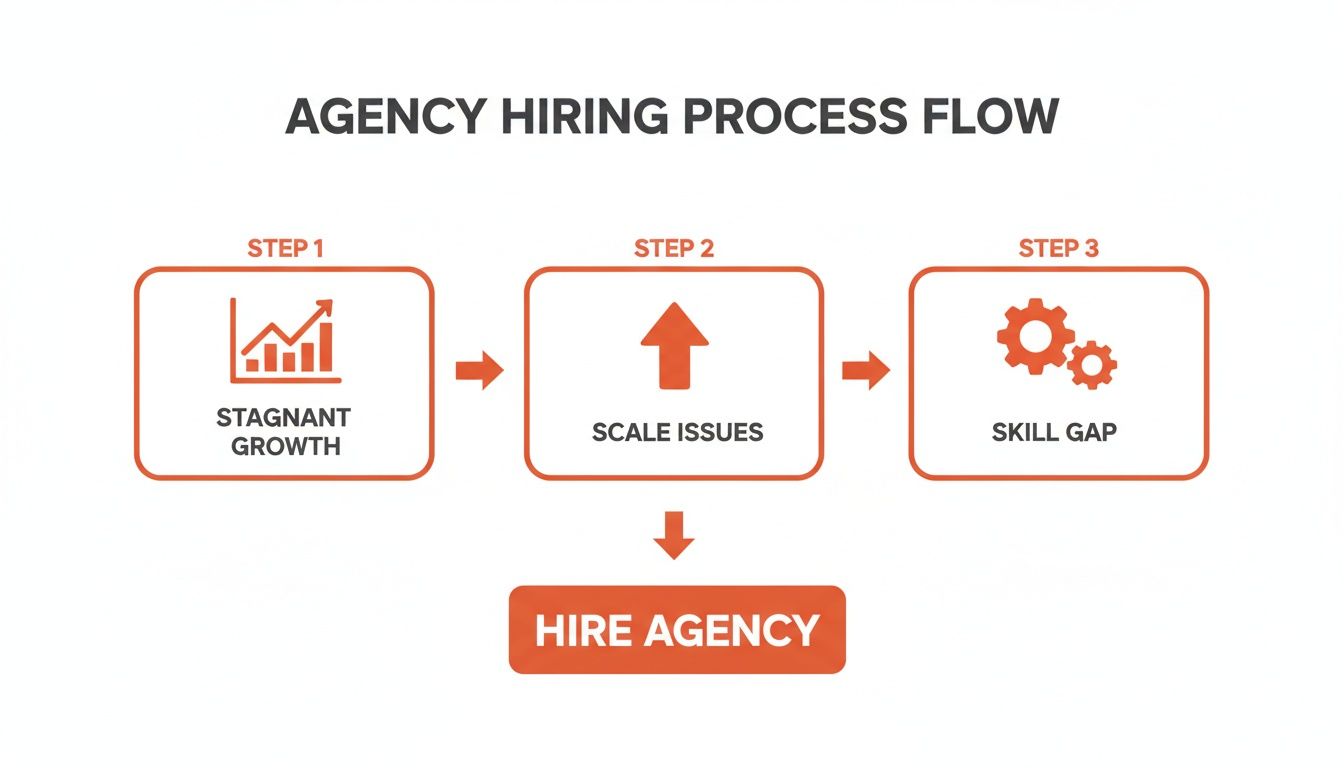
If you see these signals in your own business, it’s a clear sign that bringing in external expertise could be the key to breaking through those growth hurdles.
Creating Your Shortlist
Once you’ve got a handful of promising candidates, it’s time to do some digging. Hunt for case studies on their websites that reflect your own goals. If you're an e-commerce brand trying to boost sales, look for examples where they've done exactly that. Pay close attention to the metrics, especially the Return on Ad Spend (ROAS) they delivered.
Belgium, for example, has a seriously thriving community of social media agencies. A quick look at Sortlist reveals top-rated local firms with a track record of 1636 completed projects and hundreds of verified reviews. These agencies are often naturals at creating campaigns for Belgium's multilingual audience, making them a solid choice for businesses targeting both local and wider European markets.
The Power of a Good RFP
A Request for Proposal (RFP) is your secret weapon. Don’t think of it as a boring questionnaire; it's a tool to test an agency's strategic chops. Ditch questions like "How many years have you been in business?" and instead, ask things that force them to think critically about your specific challenges.
A strong RFP should get answers to these key questions:
Strategic Approach: "Based on our website and social channels, what's our single biggest missed opportunity, and what would your 90-day plan be to tackle it?"
Team Structure: "Who would be our day-to-day contact, and what's their specific experience in [your industry]?"
Performance Measurement: "What KPIs would you prioritize for our goal of [your primary goal], and how will you report on them?"
Tools and Technology: "What platforms and software do you use for analytics, reporting, and content management?" This gives you a peek into their technical capabilities.
For instance, their ability to use the best tools for agencies to analyze Instagram Reels in bulk can signal they're equipped to manage high-volume content and pull meaningful insights from the noise.
Vetting and Watching for Red Flags
With proposals in hand, it’s time for the final checks. The most important part of this whole process is checking references. Don't just ask for a list of their happiest clients. Be brave and ask to speak with a client whose project had some bumps in the road, or one from an industry similar to yours.
Get right to the point with your questions:
"How did the agency communicate when a campaign wasn't hitting its targets?"
"What was the onboarding process actually like?"
"Was the team proactive with new ideas, or did you have to push them?"
This is also when you need to have your red flag detector on high alert. Be very wary of any agency that guarantees results. Social media algorithms change, and audience behaviour is fickle. A partner you can trust will promise a proven process and dedicated effort, not a specific follower count. Vague pricing or a reluctance to clearly define deliverables are other warning signs.
A solid foundation is crucial for any digital partnership. To learn more about building one, check out our guide to strategic digital marketing.
Your Next Step: A thorough vetting process boils down to three things: relevant experience proven by case studies, strategic thinking revealed through a thoughtful RFP, and transparency verified by honest client references. Don't rush this stage—the effort you put in now pays off big time down the line.
Asking the Right Questions Before You Hire
Right, you’ve whittled down your list of agencies, and now it’s time to chat. This is where you get past the slick sales pitch and really figure out what they’re made of. Forget the generic questions; you need to dig deep to uncover their strategic thinking, how they solve problems, and whether they're straight shooters.
Instead of asking, "What's your experience?"—which just gets you a rehearsed answer—you need to change the game. This stage isn’t about their highlight reel. It’s about finding out how they handle the inevitable bumps in the road.
Probing Their Strategic Mindset
A great agency doesn’t just tick boxes; they act like a partner in your business. Your job is to find out how they’d tackle the challenges and opportunities that are specific to your world. It's one thing to use a few AI tools, but as a report from the Marketing AI Institute highlights, there's a massive gap in strategic implementation. That's what separates the good from the great.
Here are a few questions to see how deep their strategic thinking really goes:
The Failure Question: "Tell me about a campaign for a client with a similar budget to ours that completely missed the mark. What went wrong, what did you learn from it, and how did you turn things around?" A solid answer will show accountability and a clear, data-driven plan for getting back on track. If they start blaming algorithms or "the market," that's a red flag.
The Opportunity Question: "Looking at our current social media presence, what's the single biggest piece of low-hanging fruit you see? What specific steps would you take in the first 30 days to go after it?" This tests if they’ve done their homework and can spot quick wins.
The Industry Question: "What recent trends in the Belgian e-commerce/SaaS/service sector do you think are most relevant to us, and how would you build them into our strategy?" This shows whether they truly understand your market or just have a one-size-fits-all approach.
Understanding Their Process and Team
How an agency gets things done day-to-day is just as critical as its big-picture ideas. You need to know exactly who you'll be working with, how they communicate, and what systems they use to keep everything on track.
Expert Tip: An agency's response to failure is often more telling than its success stories. Look for honesty, a data-driven approach to learning, and a clear communication plan for when things don't go as expected. That’s the partner you want in your corner.
Here are a couple of key areas to explore:
Team Structure: "Who will be my main point of contact, and what's their direct experience? How much access will I have to the people actually creating the content or running the strategy?" You need to make sure the senior team that sells you the dream doesn't immediately hand you off to a junior account manager.
Communication Rhythm: "What's your typical rhythm for communication and reporting? Do you use shared project management tools like Asana or Trello?" This helps set expectations for transparency and collaboration right from the start.
Assessing Their Technical and AI Proficiency
Modern social media is all about data and tech. An agency that isn’t comfortable with analytics and AI-powered tools is already playing catch-up. You don't have to be a tech wizard yourself, but you should definitely probe their comfort level with the tools that drive real results.
Ask them about their experience with AI for content creation, maybe mentioning tools like Jasper. Or get more specific. For instance, you could ask, "How would you gather real, qualitative feedback from our customers directly through our social channels?"
A forward-thinking agency might suggest using a tool like Weavely.ai to quickly build a survey or form. They could use it to capture real-time sentiment after a product launch, effectively turning a stream of audience comments into data you can actually use to improve your products and marketing.
Finally, once you're leaning towards a decision, get everything down in writing. To make sure all expectations, deliverables, and timelines are crystal clear, using a comprehensive marketing agency contract template is a smart move. It protects both you and the agency, setting the stage for a successful partnership from day one.
Setting Goals and Measuring What Matters
Likes and follows are nice, but they don't pay the bills. The single most important part of working with any social media marketing agency is tying their activity directly to your business's bottom line. If you can’t measure it, you can’t manage it, and you certainly can’t justify the investment.
The real goal here is to push past vanity metrics—things like likes, shares, and follower counts—and lock onto the numbers that tell the real story of your growth. This means setting up a clear performance dashboard from day one, built around goals that are Specific, Measurable, Achievable, Relevant, and Time-bound. Yes, the classic SMART framework still works wonders.
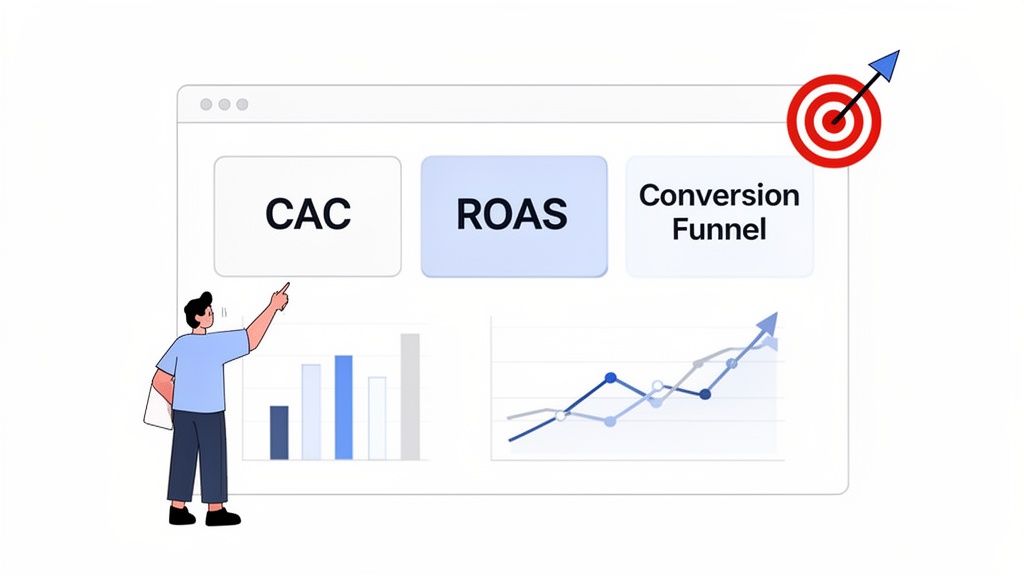
This shift in focus ensures both you and your agency are speaking the same language: the language of business results.
Moving Beyond Vanity Metrics
It's all too easy to get a buzz from a post that gets a thousand likes, but what did that post actually do for your business? A great agency will be the first to steer the conversation towards the metrics that actually matter.
These are the KPIs (Key Performance Indicators) that should be on your radar:
Customer Acquisition Cost (CAC): How much does it cost, in total marketing and sales spend, to land one new customer? If your CAC is dropping, it’s a strong sign your agency is finding more efficient ways to bring in business.
Return on Ad Spend (ROAS): For every euro you put into ads, how many euros do you get back in revenue? A ROAS of 4:1 means you're generating €4 for every €1 spent—a powerful, undeniable indicator of a profitable campaign.
Conversion Rate: What percentage of people who click your ad or visit your landing page actually do the thing you want them to do (like making a purchase or signing up for a demo)? This metric cuts through the noise and reveals the quality of the traffic your agency is driving.
Lead Quality Score: This one is huge for B2B. Not all leads are created equal, and a scoring system helps you measure how likely a lead is to become a paying customer. It ensures your sales team’s time is spent on prospects, not suspects.
By focusing on these business-centric KPIs, you transform your social media from a simple branding tool into a predictable revenue-generating machine. You can then clearly see how your investment in an agency is paying off.
Setting SMART Goals with Your Agency
Before your new agency partner even thinks about writing a single post, you need to sit down and set crystal-clear goals together. This simple step ensures everyone is aligned and working towards the same definition of success from the get-go.
A vague goal like "increase brand awareness" is basically useless. A SMART goal, on the other hand, gives everyone a clear target to aim for.
Industry Use Case: E-commerce Fashion Brand
Vague Goal: Sell more clothes on Instagram.
SMART Goal: "Increase online sales from Instagram traffic by 15% in the next quarter (Q3) by achieving a ROAS of at least 5:1 on our new collection ad campaign."
See the difference? This specific goal gives the agency a clear target and a timeline, making performance easy to measure. It aligns their creative work with the bigger business picture—and understanding this is a key part of mapping out your ideal customer journey map.
Gathering Actionable Customer Insights
Your social media channels are an absolute goldmine of customer feedback, but most businesses don't have a system for collecting it. A top-tier agency won't just post content; they’ll create feedback loops that fuel your future campaigns and even your product development.
Let's say you're a SaaS company that just launched a new feature. You can do so much more than just monitor comments. A smart agency might suggest using a tool like Weavely.ai to build and share a quick, conversational form right in your social channels. You could ask users, "On a scale of 1-5, how easy was the new feature to use?" and then follow up with an open-ended question.
This approach turns passive followers into active participants. It gives you structured data on customer sentiment that is far more valuable than a few random comments. This direct feedback can inform product updates, help you refine your marketing message, and give your agency the raw insights it needs to create content that truly connects.
Building a Modern Collaborative Workflow
A great relationship with a social media marketing agency is a partnership, not just a transaction. Once the contract is signed, the real work begins—building an efficient workflow that makes collaboration feel effortless. This is where you move from hiring a supplier to integrating a genuine extension of your team.
Success really hinges on seamless communication and complete transparency. The old model of siloed work and waiting for a monthly report is dead. Today, it’s all about shared tools, real-time updates, and a joint effort toward common goals. This proactive approach ensures everyone stays aligned and can pivot quickly when the market shifts.

Establishing Your Communication Hub
Let's be honest: email chains are where good ideas and quick approvals go to die. To build a truly collaborative partnership, you need a central communication hub where conversations are organized, searchable, and happen in real-time. This is non-negotiable for a modern workflow.
Setting up a shared Slack channel is a fantastic first step. It creates a direct, informal line to your agency team for quick questions, feedback loops, and content sign-offs. For example, a professional services firm could have separate threads for #content-approvals, #ad-performance, and #general-questions to keep everything neat and tidy.
Project management tools are just as vital. Whether you're a fan of Trello, Asana, or Monday.com, a shared project board gives you a bird's-eye view of the entire content calendar and campaign progress. You can see what’s being worked on, what’s up next, and where your input is needed, which completely eliminates the guesswork and those endless follow-up emails.
Integrating AI for Smarter Content Creation
One of the biggest concerns SMEs have about new technologies is the time investment. But when it's used correctly, AI can be a massive time-saver for both you and your agency, creating a much more efficient content pipeline.
The goal isn't to replace the agency's creativity but to accelerate it. You can use AI tools like Jasper or Copy.ai to generate initial drafts for social media posts or spitball blog ideas. This gives the agency a solid starting point that they can then refine with their strategic expertise and deep knowledge of your brand voice.
Actionable Tip: You provide the raw ingredients (your business knowledge and initial AI drafts), and the agency acts as the expert chef, turning those ingredients into a polished, high-impact final product. This simple step can cut content creation time by 20-30%, leading to more content and faster campaign launches.
Tapping into Influencer Marketing Expertise
A huge, often overlooked, benefit of working with social media agencies is gaining access to their specialized knowledge in areas like influencer marketing. This strategy is exploding in popularity, and for good reason. Influencer marketing is surging in Belgium, with nearly 70% of Benelux companies integrating it into their strategies and 90% of respondents predicting its role will only expand.
Belgian businesses, in particular, find that influencers make campaigns feel more human, with 89% favouring micro-influencers for their superior engagement rates. You can dig deeper by exploring the full influencer marketing report.
But finding the right creators can be a massive headache. This is exactly where your agency's network and experience become invaluable.
Real-World Use Case: A Belgian E-commerce Store
A local e-commerce brand selling sustainable home goods wanted to reach a younger, eco-conscious audience. Instead of spending weeks manually searching Instagram, their agency used its connections to partner with three Belgian micro-influencers focused on sustainable living.
The agency handled all the negotiations, briefing, and content approval. The result? An authentic campaign that drove a significant lift in website traffic and sales from a highly targeted demographic. This is a perfect example of leveraging an agency's specialized skill set for a direct business outcome. Your agency partner should be able to identify, vet, and manage these relationships for you.
Common Questions About Hiring an Agency
Stepping into the world of social media marketing agencies can bring up a lot of questions. It’s a big decision, and you want to get it right. Let's tackle some of the most common queries we hear from business owners, with direct, jargon-free answers to give you clarity and confidence.
How Much Should I Expect to Pay?
This is the big one, and the honest answer is: it varies wildly.
For a small to medium-sized business in Belgium, you could be looking at a monthly retainer starting around €1,000 for basic account management and content posting. If you need a more comprehensive strategy—think content creation, community management, and paid ad campaigns—expect to budget anywhere from €2,500 to over €5,000 per month.
But don't let the price tag be your only guide. Always ask for a detailed breakdown of what's included. The real focus should be on the potential return on investment (ROI). A cheap agency that delivers zero results is far more expensive than a pricier one that doubles your qualified leads.
Be very cautious of any agency promising the world for an unusually low fee. It's often a sign they're cutting corners somewhere.
What Is a Typical Contract Length?
Most reputable agencies will propose an initial contract of three to six months. This is a perfectly reasonable timeframe.
It gives them enough time to do their research, roll out the initial strategy, gather meaningful data, and actually start showing you some tangible progress. Social media isn't an overnight fix; a good strategy needs a little room to breathe and gain traction.
After this initial term, many contracts will shift to a more flexible month-to-month basis, usually with a 30-day notice period. This setup benefits both sides: the agency gets the security to do their best work, and you get the freedom to continue only if you're happy with the results.
Red Flag Alert: Be very wary of any agency that tries to lock you into a 12-month contract from day one. A confident agency will have no problem proving its value before asking for that kind of long-term commitment.
How Involved Do I Need to Be?
While the whole point of hiring an agency is to offload the heavy lifting, your involvement is absolutely vital for success. The agency brings the social media expertise, but you bring the deep, invaluable knowledge of your business, your customers, and your industry.
Plan to dedicate a few hours each week, especially during the onboarding phase. This time will be spent on things like:
Strategy Sessions: Aligning on goals, target audience, and key messaging.
Content Approvals: Making sure the brand voice and visuals are spot-on.
Performance Reviews: Chatting through the monthly reports and planning the next steps.
The best agency relationships are true partnerships. Regular check-ins and open communication ensure the social media strategy never drifts away from your core business objectives. You provide the vision; they handle the execution.
Can an Agency Guarantee Results?
In a word: no. If an agency guarantees a specific number of followers, leads, or sales, you should run in the other direction. This is one of the biggest red flags in the industry.
Social media is a dynamic, unpredictable environment. Algorithms change, trends shift, and audience behaviour is never set in stone.
So, what should a good agency guarantee? They should guarantee their process, their effort, and their expertise. They’ll set realistic forecasts based on data and experience. They’ll promise transparency in their reporting, open communication about what’s working (and what isn’t), and the agility to pivot the strategy to get the best possible results. They're guaranteeing a professional, data-driven effort, not a magical outcome.
