Jan 22, 2026
The Lean Business Canvas is your entire business idea, captured on a single, actionable page. Forget the thick, dusty business plan document. This is about getting to the point, testing your core assumptions, and finding a path forward without burning through your time and money. Think of it as your one-page roadmap to building a smarter, faster, and more resilient business.
Your One-Page Roadmap to Business Success
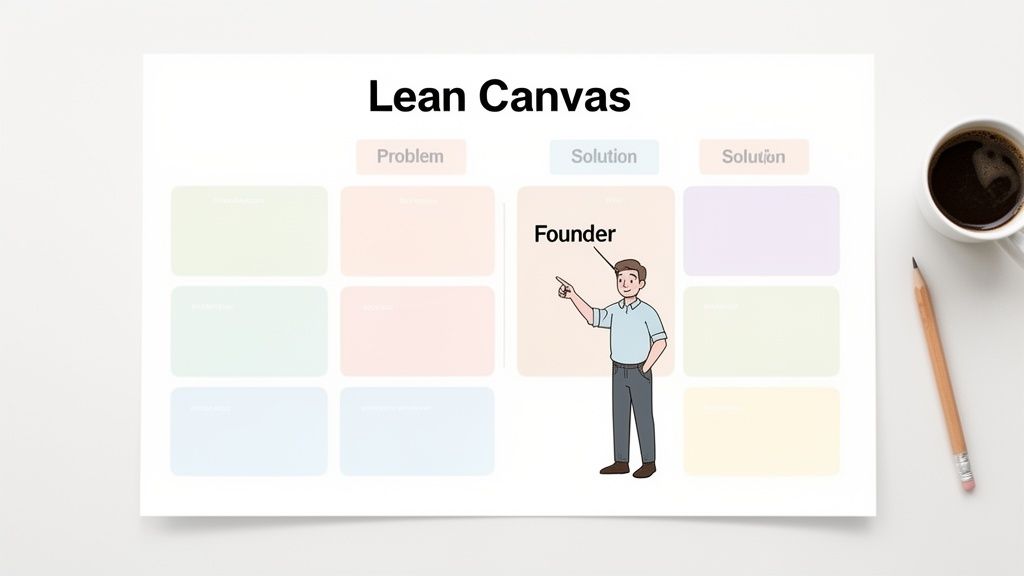
If the thought of writing a 50-page business plan makes you want to give up before you’ve even started, you're not alone. For today's fast-moving entrepreneurs and SMEs, traditional plans are just too slow and rigid. They’re often out of date the second they're printed. The Lean Business Canvas is the modern antidote, acting as a dynamic, living blueprint for your venture.
Created by Ash Maurya, this framework is a smart adaptation of the original Business Model Canvas. While both are fantastic single-page tools, they're built for different jobs. The Business Model Canvas is great for mapping out an existing business, but the Lean Canvas is purpose-built for the messy, high-risk world of a new idea.
Built for Speed and Action
So, what's the big difference? It all comes down to focus. Instead of getting bogged down with partners and infrastructure, the Lean Canvas forces you to start with the two things that matter most: the Problem and your Solution. This problem-first approach is a game-changer. It makes sure you’re actually building something people desperately need before you sink your life savings into it.
This shift makes it the perfect tool for SMEs because it encourages a much more agile way of working. It helps you quickly sketch out and test your biggest assumptions about:
Your Customers: Who are they, really, and what's keeping them up at night?
Your Value: What makes your solution the one they can't ignore?
Your Viability: Can this actually make money and stick around for the long haul?
To really get why this is so powerful, it helps to understand the Lean Startup methodology it comes from. That whole philosophy is about learning and iterating as fast as possible, rather than getting stuck in analysis paralysis.
The Lean Canvas isn’t a form to fill out; it’s a thinking tool. Its purpose is to force clarity, identify your riskiest assumptions, and create a roadmap for systematic testing.
Ultimately, the canvas cuts through all the noise. It helps you zero in on what truly matters, turning your idea from a static concept into a living model you can test, tweak, and grow. This guide will walk you through each block, step-by-step, so you can build a smarter, more resilient business.
Deconstructing the Nine Building Blocks
Think of the Lean Canvas as a single-page blueprint for your entire business idea. It’s made up of nine interconnected pieces that, when you put them all together, give you a surprisingly clear picture of what you’re trying to build. Filling it out isn't about writing a perfect, formal plan; it's about asking the tough questions upfront and getting your best guesses down on paper.
To make this feel less abstract, we’ll walk through each block using a running example: a hypothetical Belgian e-commerce store we'll call "EcoWeave". Their idea is to sell stylish, sustainable home goods made by local artisans. Let's build their canvas together.
Problem
This is the absolute heart of your business. Before you even dream about your solution, you have to nail down a problem that real people are actually struggling with. If there’s no real problem, there’s simply no market for your product.
For EcoWeave, the founders pinpointed a few key frustrations:
Problem 1: Environmentally conscious shoppers in Belgium find it hard to source high-quality, ethically made home decor that doesn’t look mass-produced.
Problem 2: It’s almost impossible to verify the vague "sustainability" claims made by big-box brands.
Problem 3: Talented local Belgian artisans don't have a modern, wide-reaching platform to sell their goods.
See how specific these are? They’re genuine pain points, not just vague concepts. A good problem statement is one your target customer would read and immediately think, "Yes, that's exactly my issue!"
Customer Segments
Okay, so you know the problem. Now, who has it? Whatever you do, don't say "everyone." The more laser-focused you are here, the easier it will be to find and connect with your very first customers.
EcoWeave isn't for every homeowner. Their ideal customer segments are quite specific:
Primary Segment: Eco-conscious millennials (ages 25-40) living in urban centres like Brussels or Antwerp. They value great design, sustainability, and are happy to pay a bit more for authentic products.
Secondary Segment: Interior designers looking for unique, locally sourced pieces to make their client projects stand out.
These segments are clear and, most importantly, targetable. You have a good idea of where to find them online, what blogs they read, and what they genuinely care about.
Unique Value Proposition (UVP)
Now for the magic. How will you solve their problem in a way nobody else is? Your UVP is a single, clear, and compelling message that explains why you’re different and worth their attention. It's the promise you make to your customers.
EcoWeave’s UVP might be something like:
"Beautifully crafted, sustainable home goods from Belgian artisans, delivered to your door. Style you can feel good about."
This little statement instantly tells you what they sell, who it's for, and the emotional payoff (feeling good about your purchase). It’s simple, powerful, and speaks directly to the problems their customers are facing.
Solution
This is where you finally get to talk about your product. The trick here isn't to list every single feature you've ever dreamed of. Instead, focus on the top three or four core elements that directly tackle the problems you identified earlier.
For EcoWeave, the solution isn't just "an e-commerce website." It's more thoughtful than that:
A curated online marketplace featuring exclusive products from vetted Belgian artisans.
A "Maker Story" on each product page, showcasing the artisan and the sustainable materials they used.
A simple, carbon-neutral delivery process.
Notice how each part of the solution maps directly back to a customer problem? That’s how you make sure you’re building something people will actually want. For a deeper dive into all the fundamental components, you can explore a comprehensive guide to Lean Canvas and its 9 building blocks.
Channels
How are you actually going to reach your customers? Your channels are the pathways you’ll use to get your UVP in front of the right people. You need to think about where your target audience spends their time.
EcoWeave's initial channels could be:
Digital: Instagram and Pinterest marketing, targeting users interested in sustainable living and interior design.
Partnerships: Collaborations with Belgian eco-bloggers and interior design influencers.
Physical: Pop-up shops at local artisan markets in Ghent and Bruges to build brand awareness and get face-to-face feedback.
Understanding these paths is critical for both marketing and sales. It’s not enough to just have a website; you need to build bridges to your customers. Mapping out these touchpoints is a huge part of creating an effective customer journey map.
Revenue Streams
Let’s talk money. How will your business actually generate income? This might seem obvious, but it’s vital to be specific. Are you selling a product, a subscription, a service? And what's your pricing strategy?
EcoWeave’s revenue model is pretty straightforward to start:
Direct Sales: Revenue from selling home goods on the website (e.g., a €50 markup on a handcrafted vase).
Potential Future Stream: A curated "discovery box" subscription for home decor lovers.
Thinking about revenue this early helps you figure out if your idea can become a viable business, not just a fun side project.
Cost Structure
What are the main costs of getting your business off the ground and running? List the major expenses needed to deliver your solution to your customers. Being brutally honest here is crucial for financial planning.
The main costs for EcoWeave would likely include:
Platform Costs: Website development, hosting, and e-commerce software fees.
Customer Acquisition Costs (CAC): The money spent on social media ads and influencer marketing.
Operational Costs: Packaging materials, shipping partner fees, and payment processing fees.
You don't need a perfect spreadsheet just yet, but you do need to have a clear idea of where your money will be going.
Key Metrics
How will you know if you're succeeding? Your key metrics are the numbers that tell you if your business is healthy and growing. Steer clear of "vanity metrics" like social media likes and focus on figures that reflect real customer behaviour.
For an e-commerce business like EcoWeave, the most important metrics are:
Conversion Rate: What percentage of website visitors actually make a purchase?
Average Order Value (AOV): How much does the average customer spend in a single transaction?
Customer Lifetime Value (CLV): How much revenue does one customer generate for you over time?
Tracking these numbers tells you what’s working and what isn’t, allowing you to make decisions based on data, not just guesswork.
Unfair Advantage
This is often the trickiest block to fill out. An unfair advantage is something that cannot be easily copied or bought by your competitors. It's your secret sauce, your competitive moat.
"The only real competitive advantage is that which cannot be copied and cannot be bought." — Jason Cohen
It’s not just "great customer service" or "a beautiful website"—those can be replicated. For EcoWeave, a genuine unfair advantage could be:
Exclusive contracts with renowned but hard-to-find Belgian artisans. This creates a unique product catalogue that competitors simply can't match.
A strong, authentic community built around the brand's sustainable mission. This fosters a sense of loyalty that goes far beyond the products themselves.
Your unfair advantage is what will protect your business for the long haul. It might not be obvious at first, but it’s something you should always be working to build. Putting these nine blocks together gives you a dynamic, at-a-glance view of your entire business model, ready for you to test and refine.
Putting Your First Lean Canvas into Action
Knowing the nine blocks is a great start, but the real value comes from getting your hands dirty and building your first canvas. This isn't about creating a perfect, final document. Think of it more as the kick-off for a process of brainstorming, questioning, and most importantly, identifying the biggest gambles in your business idea.
For many SMEs, the main hurdles are always time and resources. The good news? The Lean Canvas is designed for this exact reality. It forces you to focus your efforts where they matter most, stopping you from pouring money into an idea that hasn't been stress-tested in the real world.
Starting the Brainstorm
The best way to begin is by getting the right people in a room together. Grab your co-founder, a few key team members, or even a trusted advisor for a collaborative session. The goal here is just to get as many initial hypotheses as possible onto the canvas. Don't overthink it at this stage; just get the ideas out.
Print or Draw a Large Canvas: Get a big physical copy you can stick on a wall or pull up a digital version on a shared whiteboard.
Use Sticky Notes: Assign one idea per sticky note. This makes it dead simple to move, remove, and replace assumptions as you talk things through.
Timebox Each Section: Give yourself no more than 10-15 minutes for each of the nine blocks. This keeps the momentum going and prevents analysis paralysis.
Start with Problem and Customer Segments: Always, always begin here. If you can't clearly define a painful problem for a specific group of people, the rest of the canvas is just pure guesswork.
This initial process is a vital first step in the wider product management life cycle, helping to get your team aligned on a shared vision right from day one.
This conceptual flow shows how every great business idea starts by linking a real-world problem to a potential solution, with key metrics acting as the proof that your solution is actually working.
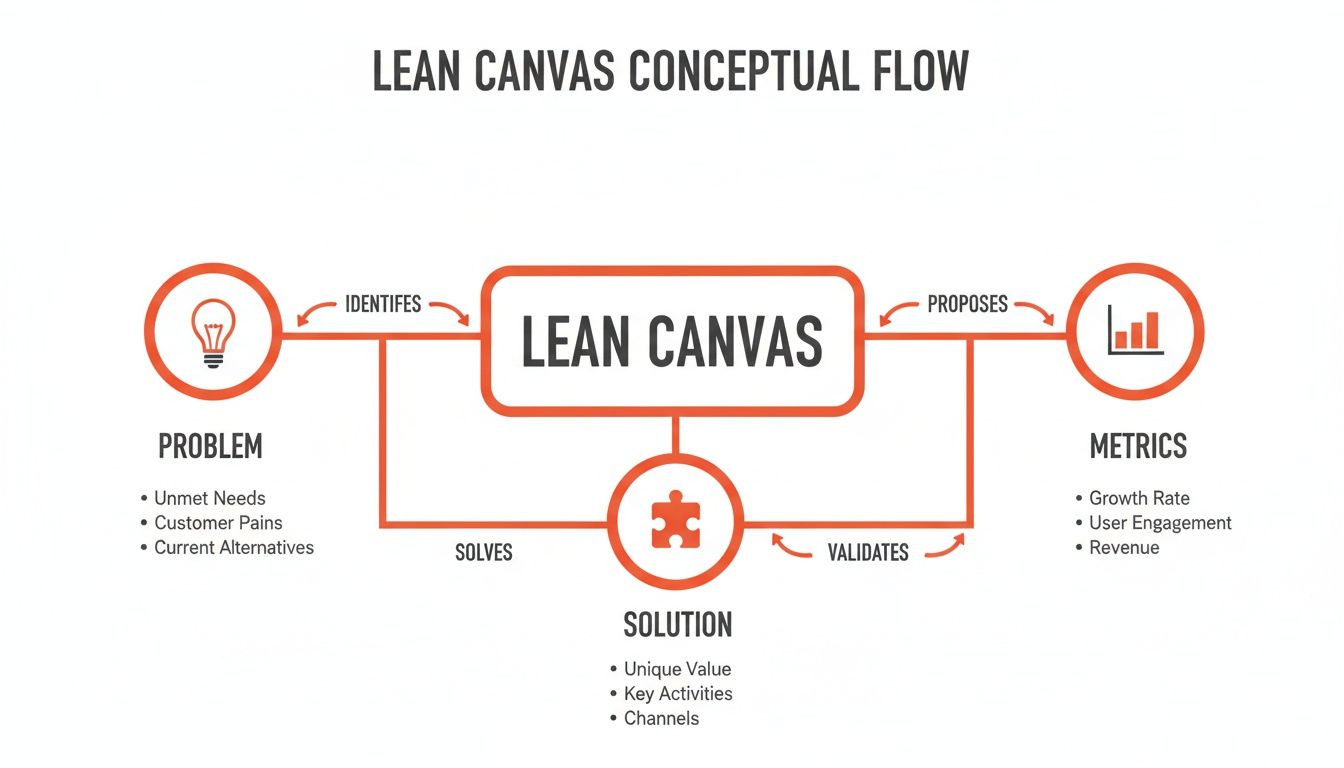
This visual really hammers home the point: without a validated problem, your solution has no foundation. And without metrics, you're just flying blind, with no way of knowing if you're on the right track.
Gathering Your First Bits of Data
Your first canvas will be filled with assumptions, not facts. The very next step is to gather some quick-and-dirty data to see if you’re even heading in the right direction. You don't need a massive budget or a data science team for this.
A simple online survey is one of the most effective ways to get early feedback. You can use a tool like Weavely.ai to quickly build and share a form that helps validate your 'Problem' and 'Customer Segments' blocks. Ask pointed questions like:
"How do you currently deal with [the problem you identified]?"
"Have you ever paid for a solution to this problem? If so, what did you use?"
"Which of these challenges is most frustrating for you?"
The answers you get back are invaluable. They provide direct feedback from potential customers, helping you refine your initial guesses with some real evidence.
Identify Your Riskiest Assumptions
Once your canvas is filled with those first ideas, it's time to get critical. Look at every single sticky note and ask your team the killer question: "If this assumption is wrong, will our entire business idea fall apart?"
The goal is not to be right. The goal is to find out if you're right as cheaply and quickly as possible. This means prioritising your riskiest assumptions for testing first.
For example, if you're building a new SaaS tool, the riskiest assumption might not be "Can we build it?" but rather "Will anyone actually pay for it?" That’s the assumption you need to test immediately, long before writing a single line of code.
This practical, guided approach is absolutely essential. Research from McKinsey shows that companies that regularly reallocate resources—a core lean principle—outperform their less dynamic peers in total returns to shareholders by 30 percent. A structured, step-by-step process is vital for applying these powerful ideas effectively.
How Real Businesses Use the Lean Canvas
Theory is great, but seeing the Lean Canvas in action is where its true power becomes clear. To move from abstract blocks on a page to a real-world strategic tool, let's explore how three different Belgian businesses might actually use it.
We'll look at a SaaS startup, an e-commerce store, and a freelance consultant to show just how adaptable the framework is for completely different business models.
These simplified examples are designed to get the gears turning, helping you see the thinking behind each box and sparking ideas for your own venture.
Example 1: The SaaS Startup in Brussels
Let’s imagine "ConnectUp," a SaaS startup building a networking app for tech professionals in Brussels. Their biggest challenge isn't just building the app, but proving people will actually pay for a premium version.
Problem: Tech professionals are struggling to make meaningful connections at big, impersonal industry events. They end up wasting time talking to the wrong people.
Customer Segments: Early-career software developers and startup founders active in the Brussels tech scene.
Unique Value Proposition (UVP): "The smartest way to network. Our AI matches you with the 5 most relevant people at any tech event."
Unfair Advantage: A proprietary matching algorithm developed in partnership with a local university's AI lab. This deep technical expertise is incredibly difficult for competitors to replicate quickly.
For ConnectUp, the Lean Canvas immediately puts their riskiest assumption under a microscope: will users upgrade for AI-powered matching? Their next step is suddenly crystal clear. They need to build a minimum viable product (MVP) with basic features and test the premium matching concept with a small group of early adopters. This focus on testing before scaling saves them potentially months of development time and significant investment on a feature nobody wants.
Example 2: The E-commerce Store in Ghent
Now, let's picture "De Groene Plank" (The Green Shelf), a Ghent-based online shop selling sustainable, plastic-free kitchenware. They operate in a market that's passionate but crowded, so differentiation is everything.
Problem: Eco-conscious consumers are overwhelmed by "greenwashing" and find it difficult to trust the sustainability claims of online products.
Customer Segments: Environmentally aware families and young professionals in Flanders who make ethical consumption a priority.
Unique Value Proposition (UVP): "Beautifully curated, 100% plastic-free kitchenware with a fully transparent supply chain. A greener kitchen, guaranteed."
Unfair Advantage: Exclusive distribution rights in Belgium for three popular Scandinavian eco-brands. This unique product catalogue simply cannot be found on other local sites.
The canvas forces De Groene Plank to zero in on what truly sets them apart: trust and exclusivity. Their key metrics would revolve around customer loyalty and repeat purchases, proving their transparent approach is building a dedicated community. This intense focus on community engagement becomes their real competitive moat and directly impacts their ROI by lowering customer acquisition costs over time.
The Lean Business Canvas isn't just a planning tool; it’s a compass. It constantly points you toward your biggest risks so you can navigate them before you run out of resources.
Example 3: The Freelance Consultant in Antwerp
Finally, let's look at a freelance digital marketing consultant based in Antwerp. For a service-based business, the canvas is brilliant for refining the offering and targeting the right kind of clients.
Problem: Local retail businesses in Antwerp know they need to improve their online presence but lack the time and expertise to manage it effectively. Worse, they've often been burned by agencies that overpromise and underdeliver.
Customer Segments: Independent retail shops (boutiques, cafes, bookshops) in the Antwerp area with little to no in-house marketing staff.
Unique Value Proposition (UVP): "Pragmatic digital marketing for Antwerp retailers. I help you get more foot traffic and online sales—without the agency price tag."
Solution: A straightforward monthly retainer service that includes local SEO, social media management, and a simple, no-fluff performance report.
In this case, the consultant’s "Unfair Advantage" might be their deep personal network within the Antwerp retail community. This local trust and word-of-mouth reputation is something a larger, non-local agency can't easily buy or replicate. The canvas helps them stay laser-focused on this niche, preventing the common freelancer mistake of trying to be everything to everyone and ultimately increasing their profitability per client.
How AI Can Supercharge Your Canvas
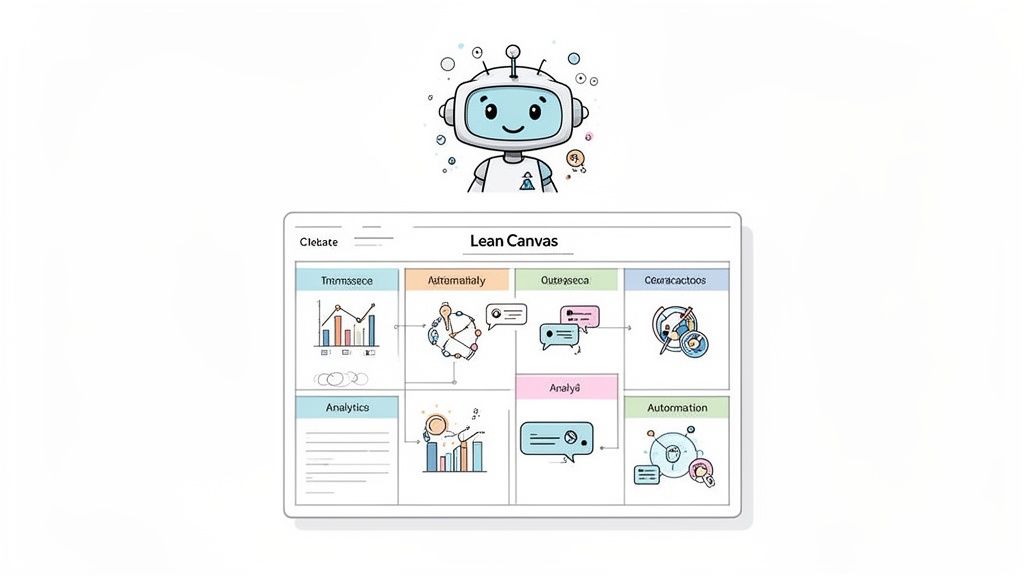
A completed Lean Business Canvas shouldn't just be a one-off exercise that gathers digital dust. Think of it as a living dashboard for your business—and modern AI tools are the engine that can power it. When you plug AI into your canvas, you transform it from a collection of smart guesses into an intelligent system that drives real-world results.
For many SME owners, the idea of using AI sounds intimidating, expensive, or too complex. But it doesn't have to be. Today's tools are accessible and can give you a serious edge without needing a technical degree or a massive budget. It’s all about using AI smartly to validate, measure, and sharpen each block on your canvas.
This isn’t just a passing trend; it's a fundamental shift. The Digital Lean Manufacturing Market is set to explode, growing by a staggering USD 79.94 billion by 2032. This points to a huge move towards blending lean principles with digital intelligence. For Belgian SMEs, it's a clear signal: combining lean planning with AI-driven insights is becoming essential to compete. You can read more about these digital lean manufacturing insights to see just how fast the market is moving.
Automating and Validating Your Canvas Blocks
Let’s get practical. Here’s how you can apply AI to specific parts of your canvas, turning your assumptions into data-backed facts.
Problem & Customer Segments: Instead of relying on gut feelings, AI-powered market research tools like AnswerThePublic can analyse real search data to uncover the exact questions and frustrations your audience has. This gives you hard evidence for your 'Problem' block.
Channels: Wondering where your ideal customers hang out online? Tools such as SparkToro analyse audience behaviour to show you which podcasts they listen to, social accounts they follow, and websites they visit. Suddenly, your 'Channels' strategy has a data-driven roadmap.
Key Metrics: This is where AI really flexes its muscles. Forget manually tracking sales and user activity in spreadsheets. AI analytics platforms can automatically monitor your key metrics in real-time, spot trends, identify at-risk customers, and even forecast future revenue. It’s like having a live pulse on your business's health.
From Static Plan to Intelligent System
Bringing AI into the fold doesn’t have to be a giant leap. You can start small by using high-impact tools that address the specific weak spots you've identified on your canvas.
For example, validating your 'Solution' is a make-or-break step. Once you think you know your customer's core problems, you need direct feedback on what you plan to build. Instead of chasing people for manual follow-ups, you could use an AI-powered form builder to create interactive, engaging surveys. This helps you gather rich qualitative data far more efficiently, allowing you to refine your solution based on what people actually say they want.
AI's true power for an SME isn't about replacing human intuition; it's about amplifying it with data. It helps you test your assumptions faster, pivot smarter, and make decisions based on evidence, not just hope.
Ultimately, the goal is to create a powerful feedback loop. Your canvas points you in a direction, AI tools measure the results of your actions, and the data you collect flows right back into improving the canvas. This cycle turns your one-page plan into a true engine for continuous improvement and sustainable growth.
Common Lean Canvas Questions Answered
As you start working with the Lean Canvas, a few questions are bound to come up. It's completely normal. This last section tackles the most common queries we get from founders and SME owners, aiming to give you clear, practical answers to help you use this tool with confidence.
How Often Should I Update My Lean Business Canvas?
Think of your canvas as a living, breathing document, not a plan that's been chiselled in stone. It needs to evolve as you learn.
A good rule of thumb is to revisit it whenever you get new information that either confirms or challenges one of your core assumptions. This could happen after a round of customer interviews, a fresh marketing campaign, or the launch of a new feature. For very early-stage businesses, that might mean weekly tweaks. For more established companies, a quarterly review is a solid starting point.
Is the Lean Canvas Only for New Startups?
Absolutely not. While it's perfectly built for the chaos and uncertainty of a new venture, the Lean Canvas is incredibly versatile.
Established businesses can use it to:
Map out the launch of a new product or service.
Explore breaking into a new market segment.
Sharpen the business model for an existing product line.
It’s the perfect tool for any project where the answers aren't obvious and the stakes are high.
What Is the Biggest Mistake to Avoid?
The single biggest pitfall is treating the canvas as a one-and-done task. It’s so easy to create a beautiful canvas, fall in love with your own ideas, and then never actually test them in the real world.
The real power of the Lean Canvas isn’t in filling out the boxes. It’s in using it as a roadmap for systematic, real-world experiments. Your first canvas is just a collection of guesses, not a statement of fact.
The goal isn't to draft a perfect plan on day one; it's to find a workable plan through constant learning and iteration. This agile mindset is vital for growth. In fact, 60% of business leaders globally see operational efficiency as their top priority, and 77% are focused on boosting productivity with technology. The canvas is a strategic tool that helps make sure your experiments are actually driving you toward those goals.
How Can I Apply the Solution Block to a Service?
For a service-based business like a consultancy or an agency, the 'Solution' block isn't about product features. Instead, you'll describe the core process, expertise, or key deliverables that solve your client's problem.
You need to think in terms of tangible outcomes. For a consultant, a good solution might look like:
"A comprehensive 90-day digital marketing roadmap."
"Monthly business intelligence performance reports and optimisation sessions."
"A fully optimised website delivered in six weeks."
Focus on the concrete value you deliver. And if you're looking to build out your reporting capabilities, you might find our guide on what is business intelligence a useful next step.
