Jan 15, 2026

Picture this: your business is a fantastic shop, but it's tucked away on a quiet side street. A search engine optimisation consultant is the expert who comes in and builds a brightly lit, direct highway from Google right to your front door. They connect you with the very customers who are already out there, actively searching for what you offer.
In short, they make your business impossible to miss online, turning searches into real business.
What Search Engine Optimisation Consultants Actually Do

At its heart, an SEO consultant's job is to increase your visibility where it matters most: the search engine results page. When people search for products or services like yours, you need to be on that first page of Google. A good consultant makes that happen, focusing on tangible outcomes like more leads and sales, not just vanity metrics.
They don't just guess what works. They use a mix of data analysis, proven strategies, and a bit of digital detective work to understand exactly how your customers search online. Think of them as part business strategist, part data analyst, all focused on one thing: driving more of the right people to your website—the ones who are ready to become customers.
At-a-Glance: What an SEO Consultant Delivers
Here’s a quick, jargon-free summary of the core pillars of SEO and what each one actually means for your business growth.
SEO Service Area | What It Means for Your Business | Practical Example for a SaaS Company |
|---|---|---|
Technical SEO | A fast, secure, and easily crawlable website that Google loves. | Fixing broken links and making sure your site loads in under 2 seconds. |
On-Page SEO | Clear signals to Google about what your pages are about. | Rewriting your "Pricing" page title to "Affordable Project Management Software Pricing" to match customer searches. |
Content Strategy | Becoming a trusted authority that answers your customers' questions. | Creating a blog post titled "5 Ways to Streamline Your Workflow with Automation Software". |
Link Building | Getting "votes of confidence" from other reputable websites. | Getting your software reviewed on a popular industry blog, with a link back to your site. |
Each of these pieces is crucial for building a strong online presence that attracts and converts customers, directly impacting your bottom line.
Decoding Customer Intent and Search Habits
One of the first things a consultant does is get inside the heads of your ideal customers. What are they typing into Google? What problems are they trying to solve? This goes way beyond just guessing a few keywords.
For instance, a law firm in Brussels might assume customers just search for "lawyer Brussels." But a skilled consultant will dig deeper and find that people are actually searching for very specific, urgent problems like "dispute with landlord Ixelles" or "SME contract review Belgium."
By understanding this intent, the consultant can shape your website’s content to provide the exact answers people are looking for. Suddenly, you’re not just another law firm; you’re the obvious solution to their immediate problem. A tactic they might use is crafting a search engine optimized press release to announce a new fixed-fee service for startups, perfectly timed to meet that specific customer need.
Fine-Tuning Your Website for Google
Once they know what customers are searching for, the focus shifts to your website itself. The consultant acts as a translator, making sure your site speaks Google's language so its algorithms can easily understand, trust, and rank your pages.
This involves a few key activities:
Technical Health Check: Is your site fast? Is it secure? Does it work flawlessly on a phone? A slow, clunky site is a major turn-off for both users and Google. A 1-second delay in mobile load times can impact conversion rates by up to 20%.
On-Page Optimisation: Carefully tweaking page titles, descriptions, and the words on the page to send clear signals about your services.
Content Strategy: Helping you create genuinely useful blog posts, guides, and service pages that answer questions and prove you’re an expert in your field.
Actionable Takeaway: A consultant prepares your website for its most important guest: the Google crawler. By making your site easy to read, navigate, and understand, they dramatically improve your chances of getting recommended to searchers. Start by running your website through Google's PageSpeed Insights tool—it's free and will show you exactly how Google sees your site's performance.
This strategic groundwork is absolutely vital. For small businesses in Belgium trying to get a piece of the country’s projected €22.71 billion e-commerce market, an expert's touch translates directly into real, measurable growth.
The Four Pillars of a Successful SEO Strategy
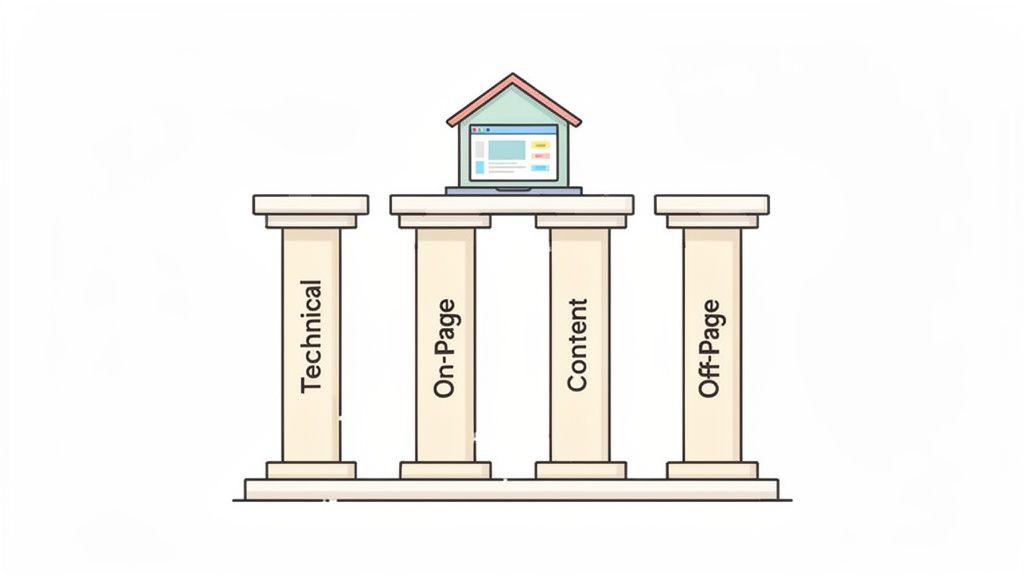
To really get what a search engine optimisation consultant does, it helps to break their work into four core areas. Think of it like building a house for your business online. Each pillar is non-negotiable; if one is weak, the whole structure starts to wobble.
Let’s run with a real-world example. Imagine you own a small, artisanal chocolate shop in the heart of Bruges. You want to bring in more tourists searching for authentic Belgian chocolate on their phones, but you also need to boost online orders across the country.
Pillar 1: Technical SEO – The Foundation
Technical SEO is the solid foundation of your digital house. It’s all the crucial, behind-the-scenes work that makes sure search engines like Google can find, crawl, and understand your website without hitting any roadblocks. If your foundation is cracked, everything you build on top is at risk of crumbling.
A consultant’s first move is almost always a deep technical audit. They’re hunting for anything that could confuse search engine crawlers or, just as importantly, frustrate your visitors. This means checking if your site is secure (look for the "https" in your URL), mobile-friendly, and lightning-fast. After all, even a one-second delay in page load time can slash conversions by 7%.
For our Bruges chocolatier, this would mean:
A mobile-first design: Tourists are on their phones, looking for directions and opening hours. The site has to work flawlessly on a small screen.
Speed optimisation: Those beautiful, high-resolution photos of pralines need to load instantly. An impatient customer is a lost customer.
A logical site map: This is essentially a blueprint for Google, clearly showing it where all the important pages are, from the e-commerce shop to your brand story.
The goal here isn't about flashy bells and whistles; it’s about building a robust, accessible structure that search engines trust. If you want to dig deeper into this, our guide on the impact of page load speeds on SEO and user retention is a great place to start.
Pillar 2: On-Page SEO – The Interior Design
With a solid foundation in place, it’s time to work on the interior design. On-page SEO is all about optimising the individual rooms—or pages—of your website. It’s the art of making each page’s purpose crystal clear to both visitors and search engines by using the right keywords, titles, and content structure.
For our chocolatier, a consultant would refine key pages to perfectly match what customers are actually searching for. The homepage title might go from a generic "Welcome to Our Shop" to a much more powerful "Artisanal Belgian Chocolate in Bruges." That small tweak immediately tells Google and potential customers exactly what the business is about.
Actionable Takeaway: Review the title of your most important service page. Does it include your service, your location (if you're a local business), and what makes you unique? A simple title change can be one of the fastest ways to improve your relevance for key searches.
Pillar 3: Content Strategy – The Valuable Furnishings
Content is what fills your house and makes it a place people want to visit. It’s the helpful blog posts, detailed product descriptions, and engaging videos that answer your customers' questions and build genuine trust. Without great content, your website is just an empty building.
A good consultant helps you map out a content strategy that establishes you as an expert. For our Bruges chocolate shop, this could look like:
Writing a blog post on "The Art of Pairing Belgian Chocolate with Local Beers."
Creating a beautifully illustrated guide to the "History of the Praline."
Filming a short, behind-the-scenes video showing how their signature chocolates are crafted by hand.
This kind of content does more than just sell; it positions the shop as a true authority, attracting people who are genuinely passionate about Belgian culture and high-quality chocolate.
Pillar 4: Off-Page SEO – Your Neighbourhood Reputation
Finally, off-page SEO is all about building your reputation out in the digital neighbourhood. This mostly comes down to earning "votes of confidence" from other respected websites, which come in the form of backlinks. When a trusted site links to yours, it’s a powerful signal to Google that you’re also a credible and authoritative source.
An search engine optimisation consultant would work on getting our Bruges chocolatier featured in popular travel blogs, local food guides, and official Belgian tourism websites. Each link from a high-quality site is like a glowing recommendation, boosting the shop's credibility and pushing it higher in search results for competitive terms like "best chocolate in Bruges." It builds authority and drives traffic from sources your customers already know and trust.
How to Choose the Right SEO Consultant for Your SME

Finding the right partner to trust with your online growth is probably the single most important decision you'll make in this process. A great consultant feels like a true extension of your team, pushing for real business results. The wrong one? They can burn through your budget and, worse, your time.
This isn't about finding the cheapest quote; it's about finding the best fit. You're looking for someone who gets your business, speaks your language, and is completely transparent about their process and what they're achieving for you.
To get this right, you need a structured way to vet potential partners. To gather consistent information, you could use a tool like Weavely.ai to build a standard questionnaire form and send it to all potential search engine optimisation consultants, making it easy to compare their proposals side-by-side.
Key Questions to Ask Every Potential Consultant
Before you even think about signing a contract, get them on a call and come armed with some sharp questions. Their answers will tell you everything you need to know about their expertise, their process, and whether they're genuinely invested in your success.
Here are the absolute must-ask questions:
"Can you share a case study from a business similar to mine in size or industry?" This is non-negotiable. It proves they have relevant experience and aren't just trying to fit your unique business into a generic box.
"How will you measure and report on the return on investment (ROI)?" You're listening for business-focused answers that go beyond just "more traffic." A good consultant will talk about tracking leads, phone calls, form fills, and, ultimately, sales.
"What does your communication and reporting schedule look like?" A true partner is proactive. You should expect regular, easy-to-digest reports (monthly is the standard) and a clear point of contact you can always reach.
"What's your approach to link building?" Their answer should be all about earning links based on quality content, not buying them. If you hear them mention buying links or using automated networks, it’s a massive red flag.
"Which tools do you use for analytics, keyword research, and audits?" You don't need to be an expert on the tools themselves, but their answer shows they invest in professional-grade software like Ahrefs, SEMrush, or Moz.
It's also worth seeing what criteria others use. When you're trying to choose the right SEO consultant for your SME, checking out a solid guide to finding the best SEO agencies can give you a much broader perspective on what to look for.
Watch Out for These Red Flags
Just as important as knowing what to look for is knowing what to run away from. Some promises sound too good to be true because, well, they are.
If a consultant guarantees you a #1 ranking on Google, walk away. No one can ethically make that promise. Google's algorithm is a complex, ever-changing beast. Legitimate experts focus on sustainable growth and best practices, not empty guarantees.
Here are a few other warning signs to keep an eye on:
Secretive or "Proprietary" Methods: Transparency is everything. A consultant should be able to explain their strategy in plain English. If they hide behind jargon or "secret formulas," it's a huge red flag.
One-Size-Fits-All Packages: Your business is unique, and your SEO strategy should be too. A custom plan built from a thorough audit of your site and competitors will always beat a generic package.
No Mention of Technical SEO: If they only talk about keywords and content, they might be missing the very foundation of good SEO. A consultant who doesn't discuss your website's technical health is ignoring a massive piece of the puzzle. This is especially true when it comes to your website platform; the technical approach can be worlds apart, as we've detailed in our Webflow vs. WordPress for your website comparison.
Choosing the right consultant is a business decision that will directly impact your bottom line. Take your time, do your homework, and trust your gut. A real partner will be eager to answer your questions and build a strategy that fits your business goals like a glove.
SEO Costs in Belgium: What Should You Actually Budget?
It’s the big question on every SME owner’s mind: "So, how much is this all going to cost?" When it comes to hiring a search engine optimisation consultant in Belgium, there’s no simple price tag. Think of it less like buying a product off the shelf and more like commissioning a custom piece of furniture—the cost depends entirely on the complexity, materials, and the level of craftsmanship involved.
The most important shift to make is moving from seeing SEO as a business expense to treating it as a strategic investment. The right consultant doesn’t just take your money; they generate a tangible return by funnelling more customers, leads, and sales directly to your digital doorstep. Their fees are a reflection of the expertise and, ultimately, the value they deliver.
Common Pricing Models You'll Encounter
As you start reaching out for quotes, you’ll likely run into three main pricing structures. Getting your head around these will help you pick the model that aligns with your budget and what you’re trying to achieve.
Monthly Retainer: This is the go-to model for any serious, long-term SEO effort. You pay a fixed fee each month for a continuous, dedicated push to improve your rankings and grow your organic traffic. It’s perfect for businesses that are in it for the long haul.
Project-Based Fees: This is for a specific, one-off job with a clear start and finish line. Think of a complete website audit, setting up the local SEO for a new brick-and-mortar shop, or a focused link-building campaign. It's a great fit when you have a well-defined, immediate need.
Hourly Rate: Some consultants will charge by the hour. This can be handy for smaller tasks, quick consultations, or training sessions where you just need an expert’s brain for a short burst.
Actionable Takeaway: If you're new to SEO, a project-based technical audit can be a great starting point. It gives you a clear roadmap of what needs fixing and helps you vet a consultant's expertise before committing to a long-term retainer. This can help address concerns about cost and complexity by starting with a defined, manageable project.
What to Expect to Pay in Belgium
Alright, let's talk numbers. While every consultant and project is unique, we can map out some realistic price ranges for the Belgian market to help you budget properly.
Small Local Businesses: For a local business in Ghent or Liège—say, a bakery or a law firm—that needs to show up in local searches, monthly retainers typically start between €750 and €1,500.
Growing SMEs: If you're a small or medium-sized business with ambitions to capture a regional or national audience, you should expect to invest somewhere between €1,500 and €4,000 per month. This budget allows for a much deeper content strategy and competitor analysis.
E-commerce & Competitive Markets: For a national e-commerce site or a business in a cut-throat industry like SaaS or finance, retainers can climb from €4,000 to €10,000+ per month. An investment at this level funds a highly aggressive, multi-pronged strategy.
These fees are a direct reflection of the deep expertise required. When you hire SEO consultants in Belgium, you’re tapping into a competitive talent market where seasoned professionals are highly valued. Senior strategist salaries can easily reach €90,000+ annually, particularly in hubs like Brussels and Antwerp. You can find more insights on hiring trends for SEO strategists in Belgium to get a better sense of the market.
Tying Costs to Business Results
A bigger price tag isn't just about buying more hours; it's about investing in a greater impact. A comprehensive e-commerce strategy naturally costs more than local SEO for a neighbourhood cafe because the potential return is exponentially larger. The real goal is always to generate a positive return on investment (ROI).
For instance, a €3,000 monthly investment that brings in an extra €10,000 in monthly sales is a clear win. The conversation with any consultant worth their salt should quickly pivot from their fees to the tangible business outcomes you can expect. Don't be shy—ask them directly: "For this investment, what kind of growth in leads or revenue can we realistically aim for in the next year?" Their answer will tell you everything you need to know about whether they're focused on your bottom line.
Real-World Examples of SEO Success in Belgium
Theory and strategy are all well and good, but seeing how it all comes together for a real business is what truly matters. Let’s look at a few anonymised examples of Belgian SMEs that worked with search engine optimisation consultants to achieve tangible, needle-moving growth.
These stories show that SEO isn't just about rankings; it's a powerful engine for boosting revenue and securing your place in the market.
Case Study 1: The Antwerp E-commerce Store
An Antwerp-based e-commerce shop sold beautiful, handcrafted leather goods. The problem? They had a stunning website but relied almost entirely on paid social media ads. These were getting more expensive by the day and delivering unpredictable results. Their organic traffic was flat, leaving them virtually invisible on Google for key terms like "handmade leather bags Belgium."
The consultant’s strategy was twofold:
Technical & On-Page Fixes: A deep audit revealed slow page speeds and poorly optimised product pages. The consultant got to work overhauling the site structure, compressing images, and rewriting every product title and description to match what customers were actually searching for.
Targeted Content: They launched a blog focused on topics their ideal customers would love, like "How to care for your leather wallet" and "Choosing the right travel bag." This attracted a highly engaged audience and quickly established the brand as an expert.
Within nine months, the results were transformative. The store saw a 110% increase in organic traffic, leading directly to a 40% uplift in online sales. Most importantly, their customer acquisition cost dropped significantly as they were no longer solely dependent on expensive ads.
Case Study 2: The Brussels B2B SaaS Company
A B2B SaaS company in Brussels offering project management software was struggling to generate demo requests online. Their website was little more than a digital brochure. Their primary source of new business was word-of-mouth referrals, which made growth slow and unpredictable.
The consultant identified that their ideal clients were actively searching for answers to complex workflow problems. The strategy was to turn the company's website into a valuable resource hub.
Pillar Content Creation: They developed in-depth articles and guides addressing specific client pain points, such as "How to Manage Remote Teams Effectively."
Lead Capture Optimisation: Each high-value article included clear calls-to-action, encouraging readers to sign up for a free trial or download a template.
This content-led approach completely changed their lead generation. The company began receiving 25-30 high-quality, inbound leads per month directly from their website. These weren't just random contacts; they were potential clients who had already seen the firm's expertise firsthand.
Key Outcome: This shift from outbound prospecting to inbound attraction is a classic example of SEO ROI. The initial investment in content continues to pay dividends month after month, creating a sustainable pipeline of new business and establishing the company as a thought leader.
Case Study 3: The Ghent Local Service Provider
A local electrician in Ghent faced intense competition. When potential customers searched for "electrician Ghent" or "emergency electrical repair," his business was buried on the third or fourth page of Google, rendering it invisible.
The search engine optimisation consultant implemented a hyper-focused local SEO strategy:
Google Business Profile Optimisation: They completely revamped the company's Google Business Profile, ensuring all information was accurate, adding professional photos, and actively encouraging customer reviews.
Localised Service Pages: They created specific pages on the website for each service in different Ghent neighbourhoods (e.g., "Lighting installation in Sint-Pieters").
Building Local Citations: The consultant ensured the business was listed consistently across dozens of local Belgian directories and trade websites.
The impact was immediate and dramatic. Within four months, the electrician was consistently appearing in the top 3 "map pack" results for his most valuable keywords. His phone started ringing daily with local jobs, leading to a 75% increase in service calls and allowing him to hire a second electrician to handle the new demand. This kind of targeted work is essential, especially for SaaS businesses where you must learn how to build a conversion-first website for a SaaS company to turn visitors into leads effectively.
What to Expect in Your First 90 Days
So, you’ve hired one of the best search engine optimisation consultants you could find and signed on the dotted line. What happens now? That first quarter is a critical period that lays the groundwork for all future growth. It’s less about watching sales skyrocket overnight and more about strategic setup and deep-dive discovery.
Think of it this way: SEO is a marathon, not a sprint. The first 90 days are about drawing the map, checking your gear, and plotting the most efficient route to the finish line. Patience is a virtue here, because the foundational work done in these early stages is what makes sustainable, long-term results possible.
Month 1: The Discovery and Audit Phase
The first 30 days are all about your consultant getting under the bonnet of your business. You'll have a kickoff meeting where they'll ask a lot of questions—about your goals, your customers, and what success actually looks like to you. They aren't just being nosy; they’re connecting your business objectives to a concrete SEO plan.
This is also when the heavy lifting of the audit begins. Your consultant will perform a comprehensive check-up on your website, looking at:
Technical Health: Pinpointing any behind-the-scenes gremlins like slow page speeds, broken links, or indexing issues that might be holding you back.
Content and On-Page SEO: Analysing your existing pages to see how well they're set up for the right keywords and, more importantly, for what your users are actually searching for.
Competitor Analysis: Sizing up your main rivals to understand their strengths, weaknesses, and where the untapped opportunities lie.
Month 2: Strategy and Quick Wins
With all that juicy audit data in hand, month two is when the strategic roadmap starts to take shape. Your consultant will present their findings and a detailed plan of action. This isn’t just a document they email over; it should be a collaborative session where they walk you through why they’re recommending certain actions over others.
This is also the time for "quick wins." These are typically smaller, high-impact fixes that can start showing results relatively quickly. Think of things like optimising your page titles or beefing up your Google Business Profile. These initial tweaks build early momentum while the bigger, long-term strategy gets rolling.
Next Steps: After the strategy presentation, your job is to provide prompt feedback and approve the plan. The faster you give the green light, the sooner the implementation can begin. Clear communication during this phase is key to keeping the project on track.
This timeline shows how an SEO strategy progresses from initial analysis to measurable growth over several months.
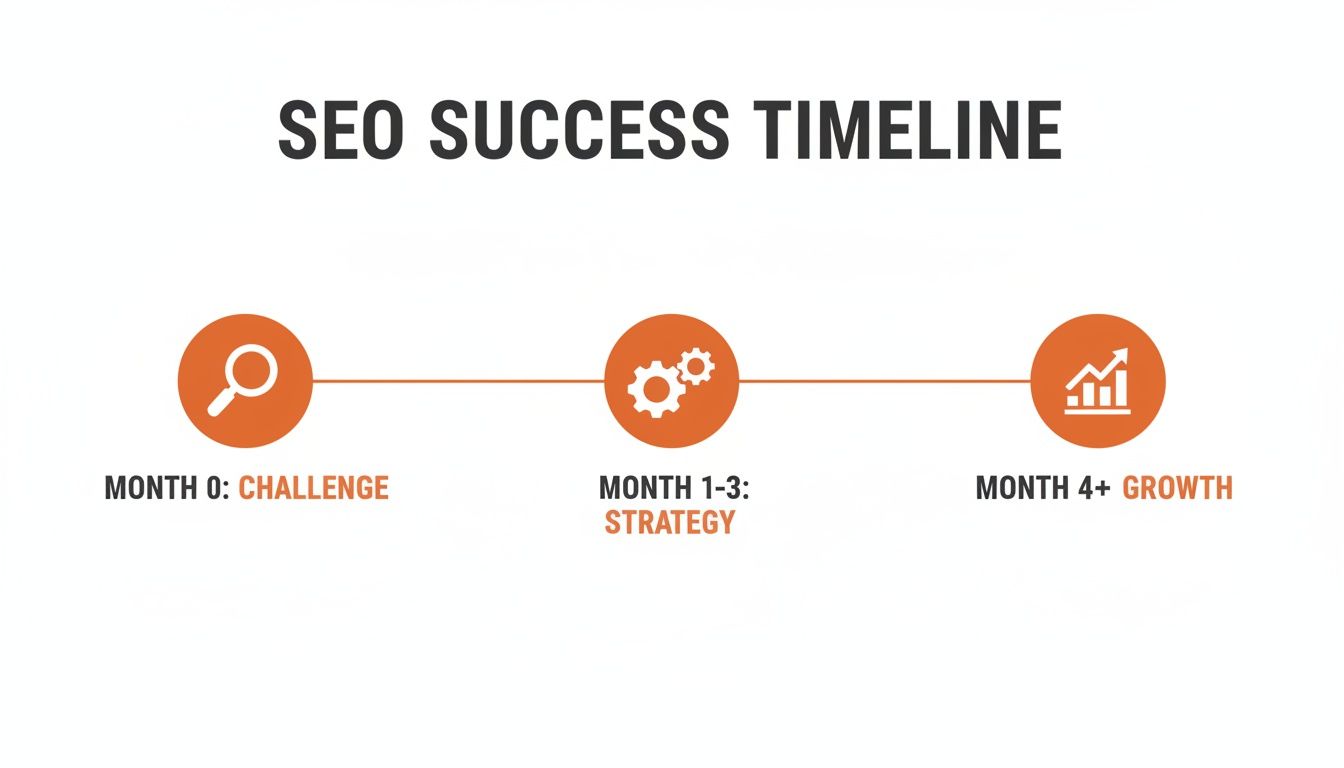
The key takeaway is that smart implementation always follows a thorough diagnostic phase, which is what leads to sustainable growth down the line.
Month 3: Implementation and Early Reporting
By the third month, the core implementation work is in full swing. This could mean creating new blog content, building high-quality backlinks, or carrying out more complex technical fixes identified during the audit. You should also start receiving your first detailed monthly reports, tracking progress on the key performance indicators (KPIs) you agreed on.
This long-term perspective is crucial. In Belgium, where SEO commands a hefty 41.2% of digital ad budgets, top-tier consultants plan for ROI timelines of 8-14 months, especially for businesses with national or international ambitions. This significant investment underscores the strategic importance of SEO in the country’s €24+ billion digital economy. You can explore more about Belgium's consulting market trends on Mordor Intelligence.
Frequently Asked Questions About Hiring an SEO Consultant
You've got questions, and that's a good thing. Making an informed choice is the first step towards a solid partnership with any search engine optimisation consultant. Here are some straightforward answers to the queries we hear most often from business owners in Belgium.
How Long Does It Take to See SEO Results?
This is always the first question, and the honest answer is: it depends. You might spot small wins like better keyword rankings within the first 3 months, but significant results—a real jump in organic traffic and quality leads—usually take 6 to 12 months to come through.
Think of it like planting a tree. At first, all the important work happens underground, building strong roots you can't see. The timeline gets pushed or pulled by things like how competitive your industry is, the current health of your website, and the pace of the strategy we put in place. SEO is a long game that builds powerful, lasting momentum.
Can I Just Do SEO Myself?
Absolutely. Learning the basics of SEO is a smart move for any entrepreneur. But it’s a deeply complex field that changes constantly. A professional consultant brings years of hands-on experience, access to specialised tools that can cost thousands per year, and the dedicated time that most SME owners simply don't have.
Hiring an expert lets you focus on what you do best—running your business—while they handle the technical side to get you faster, more meaningful, and more predictable growth.
What's the Difference Between SEO and Paid Ads?
SEO is all about earning organic (free) traffic. We do that by optimising your website so it ranks naturally in search results. This process builds a sustainable, long-term asset for your business. Once you earn a top spot, you don't pay for every click you get from it.
Paid ads, or Search Engine Advertising (SEA), are different. You're essentially paying for immediate placement at the top of the page. You get instant visibility, but that traffic disappears the second you stop paying. A really effective digital strategy often uses both: SEO for foundational, long-lasting growth and SEA for targeted, time-sensitive campaigns.
How Much Should an SME in Belgium Budget for SEO?
For a small to medium-sized business in Belgium, monthly retainers with a good search engine optimisation consultant typically range from €1,000 to over €5,000. The final figure depends on the scope of the work, how crowded your market is, and what you’re trying to achieve.
One-off projects, like a full website audit, might run anywhere from €1,500 to €7,500. It’s crucial to see this as a growth investment designed to bring in a positive return, not just another marketing cost.
