Jan 18, 2026
A customer journey map is a visual story of every interaction a customer has with your business, from the moment they first hear your name to becoming a loyal fan. Think of it as a roadmap from your customer's perspective. It shows you the exact path they take, highlights the frustrations they hit along the way, and pinpoints the magic moments that make them happy. It helps you stop guessing what customers want and start knowing how to make their entire experience better.
For a small business owner, this isn't a stuffy corporate exercise; it's a powerful tool for growth. It forces you to shift from a company-centric view ("this is our sales process") to a customer-first one ("this is what it feels like to buy from us"). Honestly, that simple change in perspective is what separates good businesses from great ones. By laying out this path, you can spot exactly where people get stuck, confused, or frustrated—and fix it.
Understanding Your Customer's Journey

For a small or medium-sized business, this isn’t some stuffy corporate exercise; it’s a powerful tool for genuine growth. It forces you to shift from a company-centric view ("this is our sales process") to a customer-first one ("this is what it feels like to buy from us"). Honestly, that simple change in perspective is what separates good businesses from great ones.
By laying out this path visually, you can spot exactly where people get stuck, frustrated, or confused. Maybe your website checkout is a bit clunky, or your follow-up emails aren't as clear as you thought. These little friction points can easily add up to lost sales and unhappy customers.
The Real-World Impact on Your Business
Getting to grips with the customer journey isn't just about making people feel good; it’s about driving real, tangible results for your business. When you smooth out the bumps in their path, you directly influence your bottom line.
Here’s what a clear customer journey map helps you achieve:
Boost Conversion Rates: By finding and fixing the roadblocks in the buying process, you make it far easier for potential customers to say "yes".
Increase Customer Loyalty: A smooth, positive experience makes customers feel seen and valued, encouraging them to come back time and time again. According to research by PwC, 86% of buyers are willing to pay more for a great customer experience.
Make Smarter Marketing Decisions: You'll know exactly which touchpoints matter most, letting you focus your budget on what actually moves the needle.
A customer journey map is your secret weapon for seeing your business through your customer's eyes. It turns abstract data into an actionable story, showing you precisely where to invest your time and resources for the biggest ROI.
For instance, a local bakery might discover through mapping that customers love their Instagram posts but get totally confused by their online ordering system. That insight allows them to simplify the process, leading directly to a jump in online sales. Or a freelance consultant could find that clients feel a bit lost after the initial discovery call. This prompts them to create a simple "what to expect next" document that builds confidence and helps close more deals.
The proof is in the numbers. Statistical analysis in the BE region reveals that customer journey mapping has led to a 19% average increase in customer satisfaction scores for SMEs, with 72% of Belgian businesses reporting measurable improvements. Find out more about how journey mapping boosts lifecycle marketing. This isn't just theory—it's a proven strategy for growth.
The Five Core Stages of Every Customer Journey
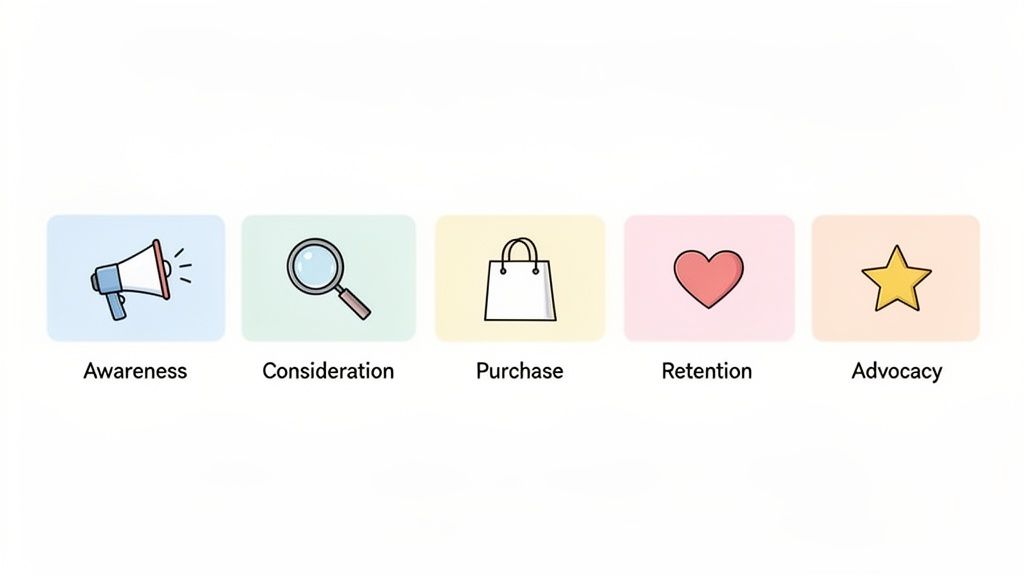
Every single relationship a customer has with a business follows a surprisingly predictable path. Whether it's their local café or a global software company, the journey has a rhythm. Nailing down this path is the first real step to creating a customer journey map that actually works. We can break it down into five essential stages, each defined by the customer's specific mindset and actions.
Think of it like dating. First, you become aware someone exists. Then you consider if they're a good match. You decide to commit, work on the relationship, and eventually, you might even tell your friends how great they are. Your customers go through a very similar process with your brand.
To get a clearer picture, let's look at what's happening in the customer's head—and what your business should be doing—at each stage.
Customer Journey Stages at a Glance
Stage | Customer Goal | Business Goal | Common SME Touchpoints |
|---|---|---|---|
Awareness | "I have a problem, and I need to understand it." | Answer questions and introduce your brand as a helpful resource. | Blog posts, SEO, social media ads, free guides. |
Consideration | "I need to compare solutions and find the best fit." | Build trust and demonstrate why you're the best choice. | Case studies, comparison pages, detailed product info, webinars. |
Purchase | "I'm ready to buy, but I need it to be easy and secure." | Make the transaction seamless and remove all friction. | Simple checkout, clear pricing, multiple payment options. |
Retention | "I hope I made the right choice. How do I get the most out of this?" | Deliver on your promise and provide excellent support. | Onboarding emails, thank you notes, feedback surveys, support chats. |
Advocacy | "This was a great experience! I want to tell others." | Turn happy customers into active brand promoters. | Referral programmes, review requests, user-generated content campaigns. |
This table gives you a bird's-eye view, but the real magic is in understanding the nuances of each phase. Let’s break them down one by one.
Stage 1: Awareness
This is the "aha!" moment. It's when a potential customer first realises they have a problem and stumbles across you as a potential solution. They are absolutely not ready to buy yet; they're just starting their research.
At this point, their goal is pure education. They're typing broad questions into Google like, "Why is my back always sore?" or "How can I get more leads for my business?" Your job is to be the helpful, no-pressure resource that answers those initial queries.
For a local physiotherapist: Awareness might spark from a blog post titled, "5 Common Causes of Lower Back Pain for Office Workers" that they find on Google.
For a B2B software company: It could be a LinkedIn ad promoting a free whitepaper on "The State of Lead Generation in 2024".
Stage 2: Consideration
Once someone understands their problem, they shift gears into the consideration stage. Now, they're actively looking for and comparing different solutions. They’ve pinned you on their map, but they’re also checking out your competitors.
Their questions get much more specific: "Which type of mattress is best for back pain?" or "Is CRM software better than a spreadsheet for managing leads?" They are weighing pros and cons, digging into reviews, and trying to figure out the best fit for their situation and budget.
During the Consideration phase, your goal is to build trust and demonstrate value. This is where you show not just what you do, but why you're the best choice for them.
For example, a freelance web designer might offer a detailed portfolio with case studies showing how they helped similar businesses boost online sales. An e-commerce store selling running shoes could have an interactive comparison tool to help customers find the perfect shoe for their running style.
Stage 3: Purchase
This is the moment of truth. The customer has done their homework, weighed their options, and is ready to pull the trigger. Your primary goal here is to make the buying process as smooth and frictionless as humanly possible. Any hiccup or moment of confusion now can lead to an abandoned cart or a lost deal.
Their focus shifts to logistics and final reassurances. They're thinking, "Is my payment information secure?" or "What's the returns policy?"
For an online jewellery brand: A clear, simple checkout process with multiple payment options and transparent shipping costs is non-negotiable.
For a marketing consultant: This involves sending a clear proposal with straightforward terms and an easy way to sign and pay the initial deposit.
Stage 4: Retention
The journey doesn't stop once the money changes hands. Far from it. The retention stage is all about delivering on your promises and ensuring the customer has a fantastic experience with your product or service. This is where you turn a one-time buyer into a loyal, repeat customer.
Good onboarding, proactive customer support, and thoughtful follow-up communication are your best friends here. You want the customer to feel confident they made the right call. A great way to check in is by using a simple form-builder like Weavely.ai to send a post-purchase feedback survey. It shows you care and gives you priceless insights.
Stage 5: Advocacy
The final stage, advocacy, is the holy grail. This is when your happy customers become your most powerful marketers. They are so delighted with their experience that they proactively recommend you to friends, colleagues, and their social networks.
An advocate doesn't just buy from you again; they actively bring you new business. This could be through leaving a glowing online review, referring a friend, or sharing your content on social media. Fostering advocacy can be as simple as creating a referral programme or just consistently delivering an exceptional experience that people can't help but talk about.
How to Build Your First Customer Journey Map
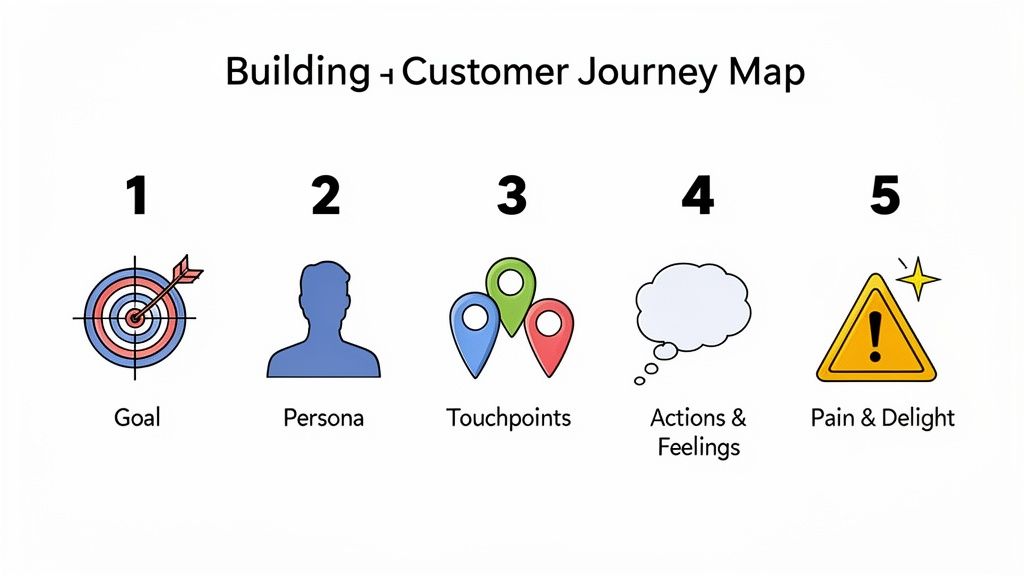
Alright, let’s get our hands dirty and turn theory into a practical tool for your business. Building your first customer journey map doesn’t require expensive software or a marketing degree—just a genuine curiosity about your customers' experiences. The goal here is progress, not perfection. Your first map will be a simple sketch, and that's exactly what it should be.
Let's walk through five straightforward steps to get you started.
Step 1: Define a Clear Goal
Before you draw a single box, ask yourself: "What am I trying to achieve with this map?" Without a clear goal, your map can quickly become a confusing mess. A focused objective will guide every decision you make.
Your goal could be anything from figuring out why customers abandon their shopping carts to improving the onboarding experience for new clients.
For an e-commerce store: Your goal might be to "Reduce checkout abandonment by 20% in the next quarter."
For a freelance consultant: It could be to "Improve client confidence and reduce questions during the proposal stage."
For a local café: Perhaps it's to "Increase repeat visits from first-time customers."
Step 2: Sketch a Simple Customer Persona
You can’t map a journey without knowing who the traveller is. A customer persona is a simple, fictional profile that represents your ideal customer. It helps you step into their shoes and see your business from their point of view.
This doesn't need to be an exhaustive, multi-page document. Start with the basics.
Think of your persona as the main character in your business's story. Giving them a name and a few key traits makes it much easier to imagine their thoughts, feelings, and frustrations.
For example, meet "Freelance Fiona." She’s a 35-year-old graphic designer who needs reliable accounting software. She's tech-savvy but short on time, values clear pricing, and gets frustrated by overly complex interfaces. Now, every touchpoint you map can be viewed through Fiona's eyes.
Step 3: List All Your Touchpoints
Touchpoints are every single place and moment a customer interacts with your brand. Think of them as the individual stops on their road trip. It’s crucial to list as many as you can think of.
Start brainstorming all the ways a customer like "Freelance Fiona" might engage with you:
Awareness Phase: Seeing a targeted ad on LinkedIn, reading a blog post on "Top 10 Accounting Tools for Freelancers."
Consideration Phase: Visiting your website's pricing page, watching a demo video, reading customer reviews on a third-party site.
Purchase Phase: Signing up for a free trial, receiving a welcome email, entering payment details.
Retention Phase: Using the software for the first time, contacting customer support with a question.
Advocacy Phase: Receiving an email asking for a review, referring a colleague to the software.
Step 4: Chart Their Actions, Thoughts, and Feelings
Now, let's add the human element. For each touchpoint, think about what your customer persona is doing, thinking, and feeling. This is where empathy comes in and where the most valuable insights are found.
Let's go back to Freelance Fiona on your pricing page:
Action: She's comparing the features of your three different plans.
Thought: "Which plan has the invoicing feature I need? Is the basic plan enough, or will I have to upgrade soon? It's not immediately clear."
Feeling: A bit confused and slightly frustrated. She’s worried about making the wrong choice.
Doing this for every key touchpoint will give you a rich, emotional layer on your map.
Step 5: Pinpoint Frustrations and Delights
With the full journey laid out, it's time to analyse it. The goal is to identify two critical things: pain points (where customers get stuck or frustrated) and moments of delight (where things go exceptionally well). These are your opportunities for improvement.
The best way to validate these points is to gather real feedback. Assumptions are a starting point, but data is what makes a map truly powerful. Creating simple, effective feedback forms is easier than ever. For example, using a tool like Weavely.ai allows you to build user-friendly surveys and forms that can be sent to customers post-purchase or embedded on your website to capture real-time insights.
A simple question like, "What was the most frustrating part of your checkout experience?" can uncover issues you never knew existed. Good design is crucial here, as a clunky or confusing user interface can prevent you from getting the answers you need. For more on this, you can check out our guide on the fundamentals of UX and UI design to ensure your feedback process is smooth.
By mapping these steps, you’ll have your first customer journey map—a powerful visual story that will guide you toward making smarter, more customer-centric decisions that fuel real business growth.
Customer Journey Maps in the Real World
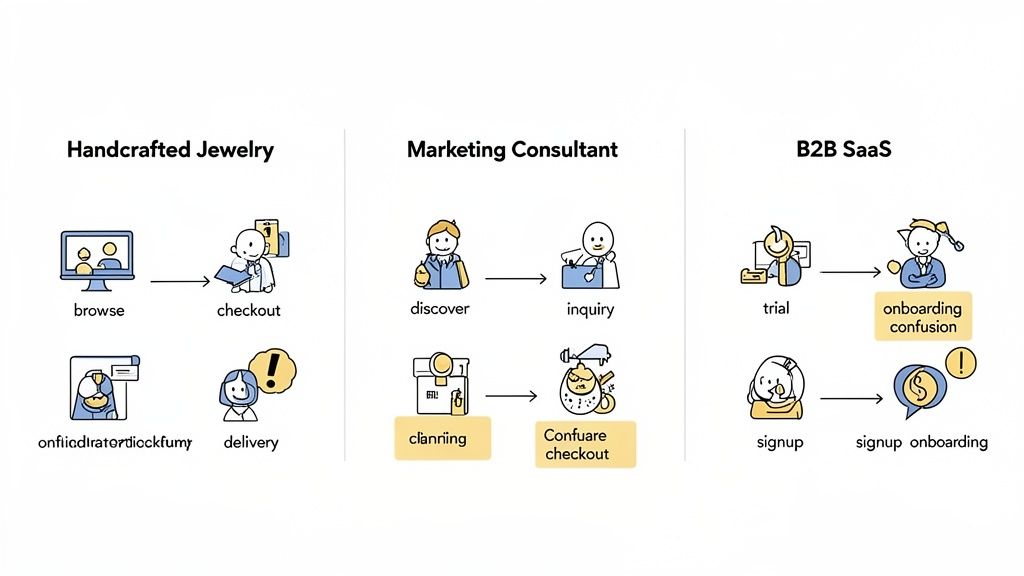
Theory is one thing, but seeing how a customer journey map actually drives results is where it all clicks. This isn't just an abstract exercise; it’s a practical, revenue-boosting tool for businesses of every size. By looking at a few relatable examples, you can see how simple insights can spark powerful changes.
Let's dive into three mini-case studies from different industries. Each one zeroes in on a specific pain point discovered through mapping and the straightforward, low-cost solution that fixed it.
E-commerce Handcrafted Jewellery Brand
First up, an online store selling unique, handcrafted jewellery. The owner noticed her social media engagement was high, but sales figures didn't match. A lot of potential buyers were adding items to their cart but vanishing before completing the purchase.
The Problem Unearthed by Mapping: By tracing the journey from an Instagram ad to checkout, she spotted a huge friction point. During the Purchase stage, her checkout process forced customers to create a full account before they could buy. This unexpected hurdle was causing a staggering 70% cart abandonment rate.
The Simple, High-Impact Solution: Her fix was simple: she added a "guest checkout" option. This small change ripped out the mandatory account creation barrier, letting customers finalize their purchase in under a minute.
The Tangible Business Outcome: Within a month, her cart abandonment rate plummeted to 25%, and her monthly online revenue shot up by 40%. The map gave her a clear, data-backed reason to make a change that directly grew her sales.
Local Freelance Marketing Consultant
Next, let's look at a freelance marketing consultant helping local businesses. He was getting plenty of initial enquiries, but a frustrating number of promising leads would go cold right after he sent his proposal. He was confused, feeling like his expertise wasn't being valued.
The Problem Unearthed by Mapping: He mapped his client's journey from their first email to signing a contract. He quickly realised his proposals, while detailed, were full of industry jargon and lacked clear, tiered pricing. During the Consideration phase, potential clients were just feeling overwhelmed and unsure of what they were getting for their money.
A customer journey map forces you to confront the gap between what you think you're communicating and what your customer is actually hearing. For the consultant, this meant his "comprehensive" proposal was just coming across as "confusing."
The Simple, High-Impact Solution: He completely redesigned his proposals. He created three distinct packages—"Starter," "Growth," and "Premium"—with simple descriptions and fixed prices. He also added a short, jargon-free summary at the top to explain the direct business value.
The Tangible Business Outcome: His proposal-to-client conversion rate doubled in the following quarter. Clients felt more confident and in control, which led to faster decisions and a more stable project pipeline.
Small B2B SaaS Startup
Finally, let's check in with a small software-as-a-service (SaaS) startup with a project management tool. They had a decent stream of free trial sign-ups, but very few users were converting to a paid plan after the 14-day trial expired.
The Problem Unearthed by Mapping: The team mapped the user journey from the second someone signed up for a trial. They found a massive hole in the Retention stage. Their onboarding process was basically non-existent; users were dropped into the software with zero guidance. People felt lost and couldn't see the tool's value.
The Simple, High-Impact Solution: They built a simple five-part automated email onboarding sequence. These emails walked new users through setting up their first project, inviting team members, and using the most valuable features. To top it off, they added small in-app tooltips to highlight these core functions.
The Tangible Business Outcome: By actively guiding users to their "aha!" moment, the startup boosted its trial-to-paid conversion rate by 15%. This simple, automated fix turned confused trial users into confident, paying customers.
How AI Can Enhance Your Journey Mapping
Creating a customer journey map is an exercise in empathy, but gathering the data to fuel it can feel overwhelming. Many business owners worry that bringing in Artificial Intelligence is too complex or expensive. The good news is that modern AI tools act more like a powerful assistant than a complicated piece of tech, supercharging your ability to understand customers without a steep learning curve or high cost.
AI doesn't replace the human element of your map; it sharpens it with data-driven precision. Instead of manually sifting through dozens of reviews, an AI tool can analyse hundreds in minutes, spotting patterns and common frustrations you might have missed. This lets you build a more accurate and effective customer journey map far more quickly.
The growth in this area is undeniable. Belgium's customer journey mapping market for SMEs is projected to grow at a 16.5% CAGR from 2025 to 2030, hitting a value of €450 million. AI integration is a key driver here, with 62% of startups reporting cost savings of 24% by using cloud-based tools.
Automating Data Analysis and Insight Generation
One of the biggest time-sinks in journey mapping is simply making sense of all your customer feedback. This is where AI truly shines, especially for a busy entrepreneur. It can instantly process vast amounts of unstructured data from all your different sources.
Think about these practical applications:
Sentiment Analysis: AI tools like MonkeyLearn can scan customer support tickets, survey responses, and social media comments to automatically classify feedback as positive, negative, or neutral. This gives you a real-time pulse on customer emotions at key touchpoints.
Topic Modelling: It can pull out recurring themes in customer feedback. For instance, it might highlight that "shipping costs" are frequently mentioned in negative reviews, pointing you to a specific pain point in the Purchase stage.
Predictive Analytics: Based on past behaviour, some AI tools can predict which customers are at risk of leaving or what they might need next. This helps you get ahead of issues before they become real problems.
Personalising the Customer Experience at Scale
A great customer journey map reveals opportunities for personalisation. AI gives you the power to act on those opportunities efficiently, making each customer feel seen without demanding hours of manual work.
For example, AI-powered chatbots can provide instant, 24/7 support during the Consideration and Purchase stages, answering common questions and guiding users. This frees up your time while ensuring customers get the help they need right away. If you're wondering how this could apply to your site, our article on whether your website needs a chatbot offers some clear guidance.
This screenshot shows an analytics tool that visualises user behaviour, revealing where they click and how far they scroll.
AI can interpret this data to identify user friction points automatically, suggesting where a personalised pop-up or a helpful chatbot could improve the experience. Beyond traditional research, you can also leverage AI-simulated shadow personas to test how different customer types might react to changes on your site before you even implement them.
The goal of AI in journey mapping isn't to create a robotic, impersonal experience. It's the opposite: to use data to deliver a more responsive, helpful, and human-centric journey for every single customer.
Ultimately, these tools handle the heavy lifting of data analysis. That leaves you to focus on the strategic side—understanding the story the data tells and making smart decisions to improve your customer's experience and grow your business.
Turning Your Map into Measurable Business Growth
Finishing a customer journey map is a massive win, but it’s really just the starting point. A map is only useful if it actually leads you somewhere. This is where you turn insights into concrete actions that improve your customer experience and, just as importantly, your bottom line.
Your map has almost certainly flagged up a few friction points. The key now is to prioritise. You don’t need to fix everything at once. Instead, zero in on the "low-hanging fruit"—the changes that will deliver the biggest impact for the least amount of effort.
Your customer journey map isn't just a diagnostic tool; it's a strategic plan in disguise. Each identified pain point is a task waiting to be assigned, and each moment of delight is a strength you can amplify.
This approach helps you chalk up some quick wins, build momentum, and see a tangible return on the time you've invested in the mapping process.
From Insights to Action Plan
Start by pulling together a simple action list from your map's findings. For each pain point, define a clear, straightforward solution. If customers are getting confused by your pricing page (a classic pain point), the action might be "simplify pricing tiers and add a comparison table."
Next, you'll want to prioritise this list. A simple framework works best:
High-Impact, Low-Effort: These are your top priorities. Think of a small tweak that solves a major customer frustration, like adding a guest checkout option.
High-Impact, High-Effort: These are bigger projects for down the line, such as a complete website redesign.
Low-Impact, Low-Effort: These are the quick fixes you can tackle when you have a spare moment, like tweaking the wording in an automated email.
Low-Impact, High-Effort: Push these right to the bottom of the list.
This method ensures your limited resources are focused where they’ll make the biggest difference first.
Tracking What Matters Most
So, how do you know if your changes are actually working? By tracking the right metrics. You don't need a complicated analytics dashboard; just a few key numbers will tell the story.
Focus on metrics tied directly to the pain points you’re trying to solve.
Fixing a clunky checkout? Keep a close eye on your cart abandonment rate.
Improving your onboarding process? Monitor your customer churn rate or gather Customer Satisfaction (CSAT) scores with a simple survey.
Clarifying your service proposals? Measure your proposal-to-client conversion rate.
Here in Belgium, the use of customer journey mapping tools among SMEs has jumped by 28% since 2022. For businesses like Digifox's clients, this translates into real results—mapping touchpoints from that first website visit to the final domain setup can slash customer drop-off rates by up to 22%.
These numbers give you objective proof that your efforts are paying off. Over time, they also feed into a smarter, more sophisticated understanding of your business's health. You can explore more about what is business intelligence to see how these simple metrics become the building blocks of a truly data-driven strategy. And to grasp the full, long-term impact of an optimised customer journey, it’s crucial to know how to calculate Customer Lifetime Value.
By turning your map into an actionable, measurable plan, you create a powerful cycle of continuous improvement. You listen to your customers, make targeted changes, measure the results, and repeat the process—driving sustainable growth, one improved touchpoint at a time.
