Jan 14, 2026
Let’s cut through the noise. Strategic digital marketing isn't about mastering every new app or chasing viral trends. It's your business's game plan for finding, winning over, and keeping customers online. Think of it as the crucial difference between just doing marketing—like posting on social media and hoping for the best—and making smart, deliberate choices that actually grow your bottom line.
What Is Strategic Digital Marketing Really About?
Many small business owners get bogged down in the tasks of digital marketing. They see an endless to-do list: post on Instagram, send an email newsletter, maybe run a few ads. But without a clear plan connecting these actions to real-world results, it's easy to feel like you're just spinning your wheels. This "spray and pray" approach rarely delivers a decent return because it's missing a central strategy.
Strategic digital marketing flips that script entirely. It forces you to start with your business goals and work backwards.
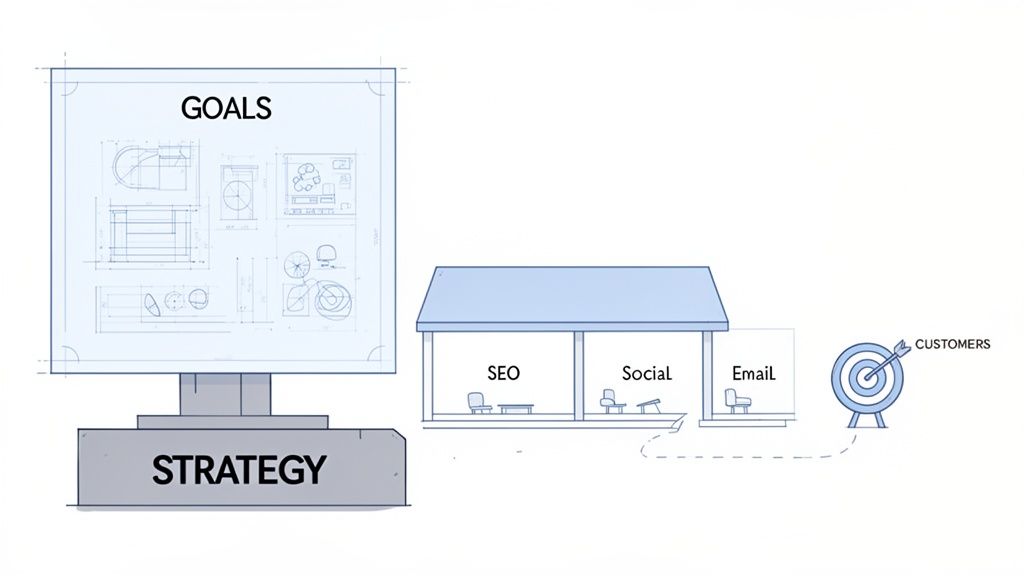
Think of it like building a house. You wouldn’t just show up with a pile of bricks and start laying them. First, you need a detailed blueprint (your business goals). Next, you pour a solid foundation (your core strategy). Only then do you start framing the individual rooms (your marketing channels like SEO, email, and social media).
This mindset ensures every single marketing activity has a clear purpose. It stops you from wasting precious time and money on things that don't move the needle. To get started, your strategy needs four core pillars. Nailing these gives you a simple but powerful framework for making decisions, even without a big team or budget.
The Four Pillars of a Digital Marketing Strategy
Here’s a quick breakdown of the essential components every business owner needs for a winning strategy.
Pillar | What It Means for Your Business | An Actionable First Step You Can Take Today |
|---|---|---|
Understanding Your Audience | Getting to know who you're really talking to. It’s about their pains, motivations, and where they hang out online—not just their age and location. | Draft a simple one-page profile of your ideal customer. Give them a name and list the top 3 problems you solve for them. |
Setting Clear Goals | Moving beyond vague wishes like "more sales" to specific, measurable targets that you can actually track. | Define one key objective, like: "Generate 15 qualified leads through our website's contact form in the next 30 days." |
Choosing the Right Channels | Focusing your limited time and money where it will have the most impact, instead of trying to be everywhere at once. | Pick the one social media platform where your ideal customer is most active and commit to posting there 3 times a week. |
Measuring and Adapting | Knowing what's working and what isn't by tracking results. This allows you to double down on wins and cut your losses. | In Google Analytics, identify the top traffic source that brings visitors who stay the longest on your site. That's a channel to focus on. |
Let’s break these down a little further.
Pillar 1: Understanding Your Audience
You can’t connect with customers if you don't know what they truly care about. This goes deeper than basic demographics. For example, a Brussels-based café targeting young professionals will use completely different language, visuals, and platforms than a B2B software firm in Ghent trying to reach CTOs. The first step is always to listen.
Pillar 2: Setting Clear Goals
What does "success" actually look like for your business right now? A strategic plan turns fuzzy hopes into concrete targets. A goal like, "Get 10 qualified leads from our website each month," is far more powerful than "get more leads," because it's specific, measurable, and gives your marketing a clear direction.
Pillar 3: Choosing the Right Channels
Your resources—both time and money—are finite. A good strategy prevents you from spreading yourself too thin. Instead of feeling pressured to be on every social media platform, you can focus. A local plumber in Bruges, for instance, will almost certainly get more value from mastering local SEO and Google Business Profile than from trying to build a following on TikTok.
Pillar 4: Measuring and Adapting
How do you know if any of this is actually working? The final, crucial piece of the puzzle is tracking your results. By monitoring a few key metrics (we’ll cover which ones later), you can see what’s delivering a return on your investment. This lets you make intelligent adjustments over time, cutting what isn't working and putting more fuel on what is.
Building Your Foundation with Audience and Goal Insights
Every powerful marketing plan is built on two simple but non-negotiable pillars: deeply understanding who you're talking to and being crystal clear about what you want to achieve.
Skipping this foundational work is like setting sail without a map or a destination. You’ll be busy, but you won't get anywhere meaningful.

Many small business owners worry that "market research" means expensive reports and consultants. The good news? You already have a goldmine of information. The key is knowing where to look and what questions to ask.
Who Are You Really Talking To?
Before you write a single social media post or spend a euro on ads, you need a clear picture of your ideal customer. This isn't just about demographics like age and location; it’s about getting inside their heads to understand their motivations, challenges, and goals. We call this detailed profile a buyer persona.
Here are some practical, low-cost ways to figure this out:
Talk to Your Current Customers: Pick up the phone and call five of your best customers. Ask them: "What was going on in your business that made you look for a solution like ours?" Their exact words are marketing gold.
Explore Social Media Groups: Find Facebook or LinkedIn groups where your ideal customers hang out. Don't sell—just listen. What questions do they ask? What are their biggest frustrations? This is free, unfiltered market research.
Gather Direct Feedback: Don't be afraid to just ask. You can quickly create and share simple surveys to get direct customer feedback. Using an intuitive form builder like Weavely.ai, you can design a survey in minutes to ask crucial questions like, "What's the #1 thing you wish our product could do?"
Real-World Use Case: A SaaS Startup A new SaaS company was struggling with high customer churn. They used a simple exit survey to ask canceling users one question: "What was the main reason you decided to cancel?" They discovered that 70% of users found the onboarding process confusing. By focusing all their efforts on simplifying the first-time user experience, they reduced churn by 40% in just three months, directly impacting their revenue.
Setting Goals That Drive Real Growth
Once you know who you're talking to, you need to decide what you want them to do. Vague wishes like "get more sales" or "grow our brand" aren't strategic goals; they are hopes. To make them actionable, they need to follow the SMART framework.
This means your goals must be:
Specific: Clearly state what you want to accomplish.
Measurable: Define how you will track progress.
Achievable: Be realistic with your resources and timeframe.
Relevant: Ensure the goal aligns with your bigger business objectives.
Time-bound: Set a clear deadline.
Let's see how this transforms a vague wish into a proper goal that gives your marketing a clear purpose and makes it possible to measure your return on investment.
Vague Wish vs. SMART Goal
Vague Wish | SMART Goal (with an actionable outcome) |
|---|---|
"I want more website traffic." | "Increase organic website traffic by 20% over the next three months by publishing two SEO-optimised blog posts per month on topics our customers ask about." |
"We need to improve our social media." | "Grow our LinkedIn followers by 300 professionals in the next quarter by sharing one client success story video each week." |
This level of clarity is the bedrock of any successful marketing effort. It turns random actions into a coordinated plan for growth. With a clear picture of your ideal customer and measurable goals, you're ready to choose the right channels to invest your time and money for the best possible return.
Choosing Where to Invest Your Time and Money
Now that you have a clear picture of your audience and your goals are set, it's time for the next big decision: where do you actually focus your energy? The digital world is brimming with platforms, but trying to be everywhere at once is a classic recipe for burnout and mediocre results.
The smarter move is to pick just a few channels where your ideal customer hangs out and commit to doing them really, really well. This way, your time and money are channeled where they'll make the biggest difference to your business's growth.
Matching Channels to Your Business Goals
Think of each marketing channel as a specialised tool. Your choice should tie directly back to the SMART goals you’ve already mapped out.
Here’s a practical look at the main options and who they’re really for:
Search Engine Optimisation (SEO): This is the long game. It’s all about making your website show up when people are actively looking for what you offer. SEO builds incredible credibility over time and generates a steady stream of high-quality traffic. Who is this for? Essential for almost any business with a website, especially professional services (like a law firm) and businesses whose customers do their homework online. Your website is your digital storefront, and as our guide on how great web design supercharges your marketing strategy explains, its design and visibility are paramount.
Pay-Per-Click (PPC) Advertising: This is your fast track. PPC involves paying for ads to appear at the top of search results (think Google Ads). It delivers immediate traffic and is incredibly measurable, making it perfect for getting leads quickly. Who is this for? A local service provider needing immediate bookings, or an e-commerce brand wanting to push a specific product sale. A study by WordStream found that businesses typically make an average of $2 in revenue for every $1 they spend on Google Ads.
Content Marketing: This strategy is about creating genuinely valuable content—blogs, videos, guides—to attract and hold onto a specific audience. It’s how you position yourself as an expert and build deep trust. Who is this for? B2B companies, businesses with a longer sales cycle, and anyone who wants to build a loyal community around their brand.
Social Media Marketing: This is where you connect with your audience on platforms like Instagram, Facebook, or LinkedIn. It's about building your brand's personality and sparking conversations. Who is this for? A fantastic playground for B2C brands, particularly in e-commerce, fashion, and food. An Antwerp-based clothing boutique, for instance, can build a vibrant community on Instagram.
Email Marketing: This is your direct line to your most valuable audience—the people who’ve already shown interest. It's perfect for nurturing leads and driving repeat business. Who is this for? Pretty much everyone. From SaaS companies sending onboarding tips to e-commerce stores offering special discounts to subscribers.
Making an Informed Decision
Don't just jump on a channel because it's trendy. The sweet spot is where your audience spends their time and which platform best serves your business goals.
For example, a local electrician will get a far better ROI from optimising their Google Business Profile for local searches than from trying to go viral on TikTok. On the flip side, an online shop selling handcrafted jewellery will probably find its first customers on visual platforms like Instagram and Pinterest.
Your Actionable Next Step: Choose just one or two primary channels to start. Seriously. Dedicate your resources to mastering them before adding another. It’s far better to dominate one channel than to be a novice at five.
This focused approach is especially critical in a competitive market. By carefully selecting your channels, you stop doing random acts of marketing and start executing a focused plan. You ensure every euro and every hour invested is aimed squarely at your business objectives, setting you up for sustainable, predictable growth.
Supercharging Your Strategy with Practical AI Tools
When someone says 'Artificial Intelligence', it's easy to picture complex, expensive systems far beyond the reach of a small business. Let's bust that myth. Today, AI is a practical and affordable assistant for entrepreneurs who want to work smarter, not harder.
Think of AI less like a technical beast and more like a tireless team member who handles repetitive jobs, brainstorms creative ideas on demand, and spots patterns in your data you'd otherwise miss. The goal is to claw back hours every week while actually making your campaigns perform better. Many SME owners worry about the cost and complexity of AI, but many of the best tools are surprisingly affordable and designed for non-technical users.
To get a competitive edge without draining your budget, explore some of the accessible generative AI tools for marketing.
Automating Content and Social Media
One of the biggest time sinks in digital marketing is creating good content. This is where AI really shines, acting as a fantastic brainstorming partner.
Content Creation: Tools like Jasper or Copy.ai can bust through writer's block. Actionable Example: An e-commerce shop owner can input, "Write five Instagram captions for a new line of eco-friendly candles. Tone: warm and inviting," and get instant, usable options. This turns a 30-minute task into a 3-minute one.
Social Media Management: Consistency is key on social media. Many scheduling tools, like Later, now have AI caption writers built in. It looks at your image and suggests relevant, engaging captions, saving you a heap of time.
Personalising Customer Communication
Making your customers feel understood is how you build loyalty. AI lets you personalise your marketing on a scale that used to be impossible for small businesses.
Take email marketing. Many platforms now use AI to analyse customer data—like what they’ve bought before—to predict who is most likely to buy again. This lets you send super-targeted offers that are far more likely to convert.
Another powerful tool is an AI-powered chatbot. These bots can answer common customer questions 24/7, freeing up your team and ensuring customers get help instantly. If you're weighing up whether this is right for your business, our guide on if your website needs a chatbot has some great pointers.
This decision tree helps visualise how to pick the right marketing channels based on whether your main goal is to build brand awareness or bring in leads.
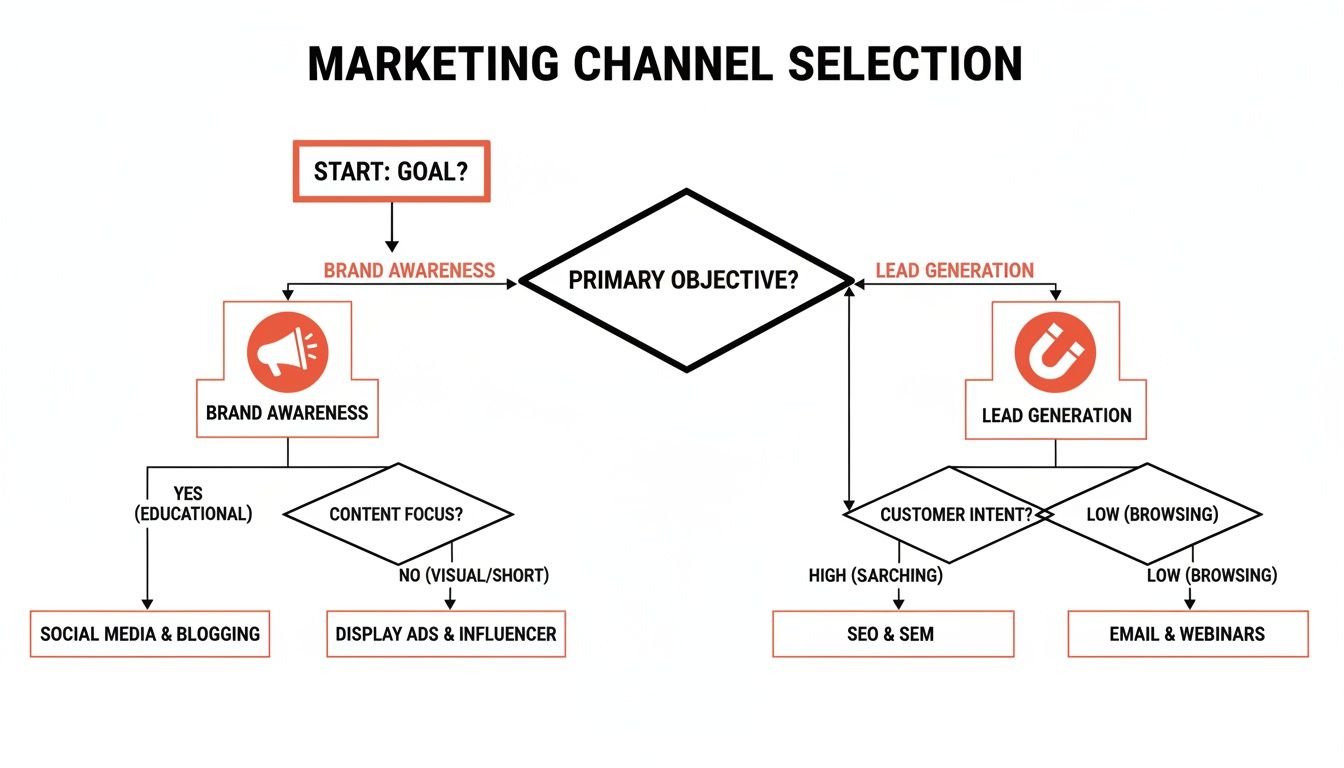
As the flowchart shows, your core business objective should directly drive your channel selection. This ensures your resources are always pointed squarely at your goals.
Gathering and Analysing Customer Insights
Understanding your customers is the bedrock of any solid strategy. AI can help you gather and make sense of customer feedback far more efficiently.
Instead of manually reading hundreds of survey responses, you can use AI tools to perform sentiment analysis. This automatically works out if feedback is positive, negative, or neutral, pulling out key themes and pain points in minutes, not hours.
This lets you quickly spot trends and make data-backed decisions. For example, by using AI-powered form builders, you can not only collect feedback but also analyse the responses to pinpoint the most common customer requests, helping you prioritise what to do next.
By bringing these practical AI tools into your workflow, you aren't just adopting new tech—you're building a more efficient, intelligent, and competitive business.
Measuring What Matters for Business Growth
A brilliant strategy is just a theory until you prove it works. The key to effective strategic digital marketing isn't tracking every possible number; it's focusing on the few metrics that tell you if you're actually growing your business.
It’s tempting to get excited about "vanity metrics" like a flurry of likes on a social media post. While these can feel good, they don’t pay the bills. True strategic measurement means looking deeper at the Key Performance Indicators (KPIs) that directly connect your marketing efforts to your bank account.
Moving Beyond Vanity Metrics
To build a sustainable business, you have to get laser-focused on the numbers that reveal the real health of your customer acquisition process. These are the metrics that tell the true story about your return on investment (ROI).
Here are the three most important KPIs every SME owner should understand:
Customer Acquisition Cost (CAC): How much does it cost you to win one new customer? (Total Marketing Spend ÷ New Customers). An efficient marketing machine has a low CAC.
Conversion Rate: What percentage of website visitors take a desired action (e.g., make a purchase, fill out a form)? It tells you how effective your marketing message and website are.
Customer Lifetime Value (CLV): How much total revenue can you expect from a single customer over their entire relationship with you? A high CLV is a sign of happy, loyal customers.
The Golden Rule: For a profitable business, your Customer Lifetime Value (CLV) must be significantly higher than your Customer Acquisition Cost (CAC). A common benchmark to aim for is a CLV:CAC ratio of at least 3:1.
Using Free Tools to Track Your Progress
You don't need expensive software to get started. A powerful and free tool like Google Analytics 4 (GA4) is more than enough for most SMEs to see what's happening on their website. GA4 helps you track where your traffic is coming from, which pages are most popular, and how users behave once they arrive.
To measure what matters accurately, it’s also important to be aware of the current data and analytics challenges in digital marketing. Knowing about these potential roadblocks helps you interpret your data correctly and make smarter decisions. This data-driven approach is essential, with studies showing that companies that adopt it are six times more likely to be profitable year-over-year.
A Real-World Success Story
Let's make this tangible. A small e-commerce shop selling artisanal chocolates noticed in their Google Analytics data that their conversion rate was surprisingly low. A lot of visitors were adding chocolates to their cart but never completing the purchase.
Digging deeper, they used a simple feedback form on the checkout page, built with a tool like Weavely.ai, asking abandoning visitors why they were leaving. The responses were overwhelming and pointed to one culprit: the shipping cost calculation was confusing and appeared too late in the process.
Armed with this direct feedback, they simplified the checkout flow and made shipping costs transparent from the start. The result? They fixed that single point of friction, and their monthly revenue shot up by 22% within two months. This is a perfect example of how focusing on one meaningful metric—conversion rate—can lead directly to a significant business outcome. It transforms marketing from a perceived expense into a powerful, data-backed engine for growth.
Creating Content That Connects and Converts
If your digital marketing plan is the engine, then content is its fuel. It’s what powers your social media, drives your SEO, and builds genuine relationships with your customers. But effective content isn't about constantly shouting about your products. It's about solving your audience's problems and proving you're the expert they can trust.
A strategic approach means creating the right content for the right people at the right time. This stops you from wasting hours writing blog posts that nobody reads.
Choosing the Right Content Format
Different content formats do different jobs. The trick is to match the format to what your customer needs and where they are in their buying journey.
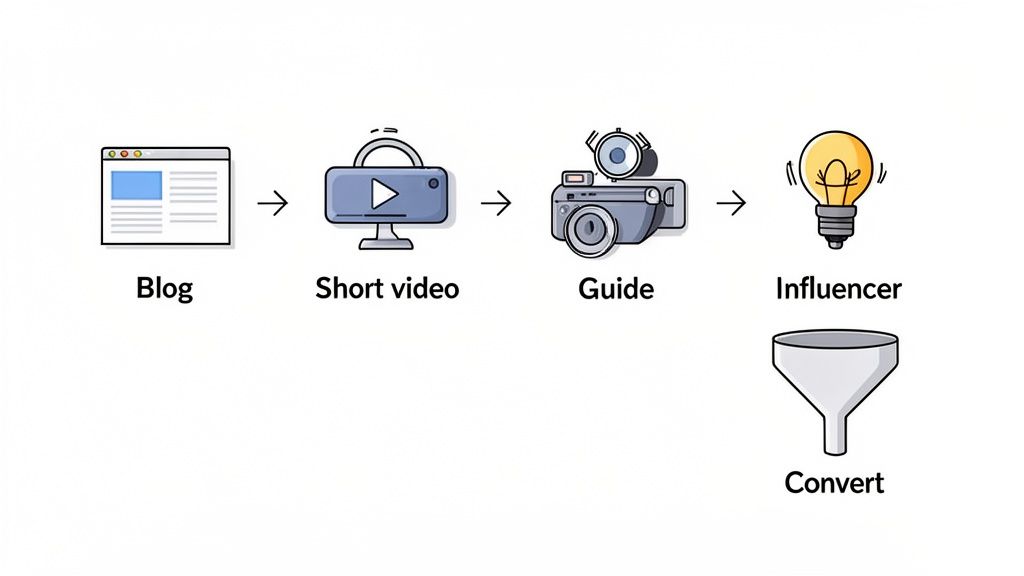
Blog Posts & 'How-To' Articles: Perfect for answering the specific questions your audience is typing into Google. They establish your authority and are gold for SEO.
Short-Form Video (Reels, TikToks): Nothing grabs attention faster. Use these to show your brand's personality, quickly demonstrate a product's value, or share a quick tip.
In-Depth Guides & Ebooks: This is how you capture leads. You offer a high-value, problem-solving resource in exchange for an email address, which lets you nurture that relationship over time.
Real-World Use Case: A Professional Services Firm A small accounting firm wanted to attract more startup clients. Instead of just running generic ads, they started a blog with articles like "5 Common Tax Mistakes New Businesses Make" and "A Simple Guide to Registering for VAT." These guides directly addressed their ideal clients' worries, establishing the firm as a helpful authority and generating a steady stream of high-quality leads.
Solving Problems Before Selling Products
The most successful content lives in the customer's world, not yours. Before you create anything, always ask: "What problem does this solve for my ideal customer?" When your content provides real solutions, you earn trust and build an audience that wants to hear from you. That’s the foundation for turning followers into paying customers.
Of course, your content needs to lead somewhere. For it to truly drive growth, it needs to guide the user to a clear next step on your website. Our article on mastering conversion-focused design offers practical tips to ensure your site helps visitors take that action.
The Power of Collaboration
You don't have to create everything by yourself. Partnering with others, especially influencers, can be a brilliant way to build credibility and reach new people. For small businesses, this doesn't mean paying massive fees to celebrities.
Micro-influencers—creators with smaller, highly engaged followings in a specific niche—are often far more accessible and effective. A local food blogger, for example, could generate more authentic buzz for a new restaurant than a national food celebrity ever could. Research shows that micro-influencers can deliver engagement rates up to 60% higher than larger influencers, making them a highly cost-effective option for SMEs.
When you turn content creation into a strategic asset, you build a powerful, long-term engine for your business's growth.
Your Strategic Digital Marketing Questions Answered
Starting out with a digital marketing plan always brings up a few practical questions about time, money, and who’s going to do all the work. Let’s tackle the most common ones business owners ask.
How Much Should a Small Business Budget for Digital Marketing?
There isn't a single magic number, but a good rule of thumb for most SMEs is to set aside 7-12% of total revenue for marketing. If you're just starting out, this could be as simple as a modest budget for a few essential tools and a small ad spend on one, highly focused channel.
The key is to start small, measure your return on investment (ROI), and then reinvest in what's actually working. For example, start with a $200 ad budget on one platform. If it generates $600 in sales (a 3:1 return), you have data-driven proof to increase that budget next month.
How Long Until I See Results?
This depends on the channels you pick. A well-targeted paid advertising campaign on a platform like Google Ads can start sending traffic and leads to your website almost immediately.
On the other hand, organic strategies are more of a long game. Building up authority and rankings through SEO and content marketing often takes 6-12 months to show significant results. A truly smart strategy blends short-term tactics for those quick wins with long-term efforts for sustainable, lasting growth.
Can I Do This Myself or Do I Need to Hire Someone?
Plenty of entrepreneurs successfully manage their own digital marketing, especially in the early days. The secret isn't to do everything at once, but to focus on mastering one or two channels before you even think about expanding.
You can also use accessible AI tools to save a huge amount of time on tasks like brainstorming content ideas or analysing customer feedback. As your business grows, you might then look at bringing in a freelancer or an agency to help scale up and handle more advanced strategies, freeing you up to do what you do best: run the business.
